
Most programs aren't short on data. They're short on a way to make perception, telematics, quality, and cabin data agree with each other.
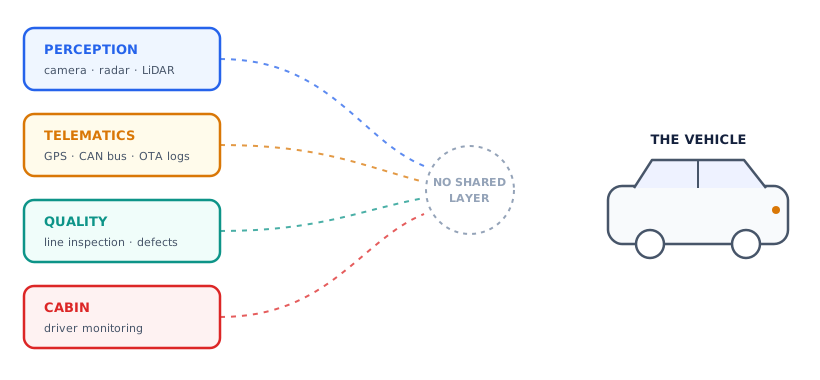
Four active data streams. Four separate quality bars. No layer connecting them back to one vehicle.
A modern production vehicle produces more raw sensor data before its first tank of gas than most companies generated in a decade of doing business the old way. Cameras, radar, LiDAR, IMUs, CAN bus signals, driver-facing cameras, over-the-air diagnostic logs — all of it streaming, all of it theoretically useful for training the next generation of ADAS, connected-car, and manufacturing systems.
Here's the part almost nobody says out loud in vendor pitch decks: most automotive data collection programs aren't struggling because they lack data. They're struggling because the data they already have was never built to talk to itself.
Data collection in the automotive industry is the practice of capturing, structuring, and quality-checking the sensor, vehicle, and driver data that trains and validates ADAS, autonomous driving, telematics, and manufacturing-quality systems. Done well, it treats a vehicle as a single physical AI system with several connected data domains — not one long stream of miles driven.
The recall investigation that exposed the real problem
Picture a mid-size ADAS supplier six weeks into a field investigation. A handful of vehicles have logged unexpected phantom-braking events on a specific stretch of divided highway. The engineering team pulls the perception logs. The fleet-ops team pulls the telematics data. The quality team pulls the calibration records from the line where the radar units were installed.
Three teams, three timestamps, three definitions of what counts as an "event." The perception team flags anything the model treats as an object crossing the path. The telematics team flags anything with a deceleration spike above a threshold tuned for insurance analytics, not safety review. The quality team's calibration log uses a different vehicle ID scheme entirely, because it was built for warranty tracking, not incident correlation.
It takes the investigation nearly three weeks to even confirm that all three teams are looking at the same nine vehicles. The actual root-cause analysis takes four days. The rest is data archaeology.
This is not a rare story. It's the default outcome when perception, telematics, quality, and cabin data are collected by four different teams, on four different timelines, with four different definitions of quality.
Automotive data isn't one dataset. It's four that rarely talk to each other
Ask most vendors "what is automotive data collection" and they'll answer as if it means one thing: cameras and LiDAR feeding an autonomous driving model. That's a real and important slice of it. It's also a fraction of what a vehicle actually generates, and treating it as the whole picture is exactly why cross-domain investigations like the one above take weeks instead of days.
ADAS and autonomous driving data
Camera, radar, and LiDAR streams captured from test fleets and production vehicles, used to train and validate object detection, path prediction, and collision-avoidance systems. This is the domain most vendors mean when they say "automotive data collection," and the one with the deepest tooling ecosystem for annotation and sensor fusion.
Connected-vehicle and fleet data
GPS location, driving behavior, battery and fuel usage, and diagnostic data transmitted from a vehicle to the cloud. It's one of the fastest-growing categories of automotive data — the connected car market alone is projected to grow from roughly $78.5 billion in 2026 to $485.2 billion by 2036, according to Fact.MR.
Manufacturing and assembly-line data
Inspection imagery, torque and fit measurements, and defect logs captured on the production line. It's the least glamorous of the four domains and the one most often kept in a separate system entirely, disconnected from the vehicle's later field performance.
In-cabin and driver-monitoring data
Driver-facing camera footage tracking gaze, head position, and attention. This domain just became mandatory across an entire continent: as of July 7, 2026, the EU's General Safety Regulation requires an Advanced Driver Distraction Warning system in every new passenger car, truck, and bus sold in the bloc.
Each domain has its own hardware, its own vendors, its own idea of what "good data" means. A perception team scores quality by trajectory smoothness and object-detection confidence. A telematics team scores it by signal completeness and transmission latency. Nobody owns the join between them — and that join is exactly where recall investigations, safety validation, and model debugging actually happen.
The long tail problem: why "miles driven" is the wrong metric
Ask an AV program how confident they are in their safety data, and most will point to a mileage counter. That number feels reassuring. It's also close to meaningless on its own, because the scenarios that actually matter are rare by definition.
Research on edge-case detection puts a number on this: a system running at 99% accuracy can still face roughly one unhandled dangerous scenario per 10,000 miles of driving. Finding enough of those events through public-road testing alone, rather than deliberately hunting for them, can require processing millions of miles to surface a few thousand meaningful edge cases — and academic work on statistical validation notes that observing rare failure events through pure distance-based testing can demand billions of miles of collected data.
That's the trap volume-first thinking sets. A fleet can log ten million uneventful miles and still be no closer to seeing the one intersection geometry, the one lighting condition, or the one unusual road-user behavior that actually breaks the model.
| Approach | Strength | Limitation |
|---|---|---|
| Real-world fleet driving | Authentic sensor noise, real human behavior, ground-truth outcomes | Rare events are rare — most miles collected add little new signal |
| Simulation / synthetic generation | Can generate edge cases on demand by varying weather, lighting, and behavior | Sim-to-real gap; synthetic scenarios don't always transfer to real-world performance |
| Scenario-based / targeted capture | Deliberately seeks out under-represented conditions instead of waiting for them | Requires an operational team that knows which gaps to chase — not a one-time setup |
The programs that make real progress on the long tail don't pick one column. They combine targeted real-world capture with simulation for scale, and they track coverage against a diversity plan instead of a mileage counter — the same discipline used across physical AI more broadly, whether the "robot" in question is a warehouse arm or a passenger sedan.
The real cost hides upstream of the dashboard
Road testing for AD and ADAS programs is expensive in ways that don't show up until a program is already underway: specialized, certified drivers, test vehicles built around small onboard data centers, and dozens of sensors streaming continuously. Industry analysis of ADAS data pipelines notes that this data typically arrives at petabyte scale as continuous binary streams under tight service-level agreements, which means there's rarely time for after-the-fact cleaning the way a typical data-mining project would handle it.
That single operational fact reshapes where the budget should go. In most data projects, the rule of thumb is that a large share of total effort goes into cleaning data after it's collected. Automotive perception pipelines don't get that luxury — if a camera is miscalibrated or a sensor drops frames mid-session, there's often no clean way to recover it later. The fix has to happen at the source: calibration logging, operator qualification, and session-level review, not a downstream cleanup pass.
Teams that treat data collection as a one-time procurement line item consistently underestimate three costs: the engineering time spent building and maintaining format-conversion and QA tooling, the ongoing cost of managing and requalifying operators or drivers, and the storage and versioning infrastructure needed as episode and session counts scale into the millions.
What teams get wrong when they treat vehicle data like one pipeline
Optimizing each domain in isolation
Perception, telematics, quality, and cabin teams each build their own tooling, their own quality bar, and their own vendor relationships. It works fine until something crosses domains — a recall, a safety audit, a model failure traced back to a manufacturing defect — and nobody can join the records without weeks of manual reconciliation.
Chasing mileage instead of coverage
A dashboard that reports "12 million miles collected" looks impressive in a board deck. It says nothing about whether those miles included night driving in heavy rain, an unusual intersection geometry, or a rare road-user behavior. Coverage against a diversity plan is a better signal than distance.
Treating in-cabin data as a compliance checkbox
With driver-monitoring cameras now mandatory across the EU and moving toward similar requirements elsewhere, cabin data has quietly become one of the largest new categories of automotive data. Teams that bolt it on as a late compliance requirement, rather than designing it into their data governance from day one, inherit privacy and data-handling risk they didn't plan for.
Skipping calibration logging to save time
Camera and sensor calibration drifts over weeks of continuous use. Without a logged baseline to compare against, a batch of otherwise-usable data can silently degrade model performance in a way that's nearly impossible to trace back after the fact — the same failure mode robotics teams see in teleoperation programs.
Treat the vehicle as a physical AI system, not four separate projects
The most useful mental shift here isn't a new tool. It's a category correction. A vehicle is a physical AI system in the same sense a warehouse robot or a humanoid platform is: a machine that senses, acts, and generates data about how well it did both. Robotics teams building for those systems already apply a consistent discipline across every data domain, rather than treating each one as its own island.
What the connecting layer actually looks like
- ✓
A shared vehicle and session identifier scheme that lets any team join perception, telematics, quality, and cabin records without weeks of manual matching
- ✓
Calibration logged at the point of capture, so drift is detectable before it silently corrupts a batch of otherwise-good data
- ✓
Task- and event-level quality scoring applied consistently, instead of each domain inventing its own definition of "usable"
- ✓
Coverage tracked against a target diversity plan — environments, conditions, and edge cases — not against a mileage or volume counter
- ✓
Annotation and labeling standards that hold across domains, so a "cut-in event" means the same thing to the perception team and the safety review team
None of this requires abandoning the specialized tooling each domain already uses. It requires a connecting layer above those tools — the operational discipline that turns four disconnected data programs into one coherent picture of how a vehicle actually behaves in the world.
The data surface is still expanding, not shrinking
Every trend line in automotive data points toward more domains generating more data, not fewer. Fleet telematics adoption is already mainstream: Mordor Intelligence's 2026 industry research cites a fleet-technology report finding that roughly 80% of commercial fleets now run at least one connected solution, with AI-enabled video telematics users reporting a 19% drop in accident costs. Hardware partnerships are pushing telematics data further into unfamiliar territory too — Bridgestone and Geotab, for instance, have started merging tire and telematics data across 4.5 million connected vehicles to feed joint safety algorithms.
On the cabin side, the EU's mandate is unlikely to stay a regional story. Regulatory bodies elsewhere are already watching the rollout, and the pattern automotive has seen before — an optional safety feature becoming a legal requirement, and legal requirements becoming permanent new data streams — is playing out again in real time.
The practical takeaway for any team building a data strategy today: don't design around the domain you have budget for right now. Design the connecting layer first, so the next domain — whatever it turns out to be — has somewhere to plug in.