

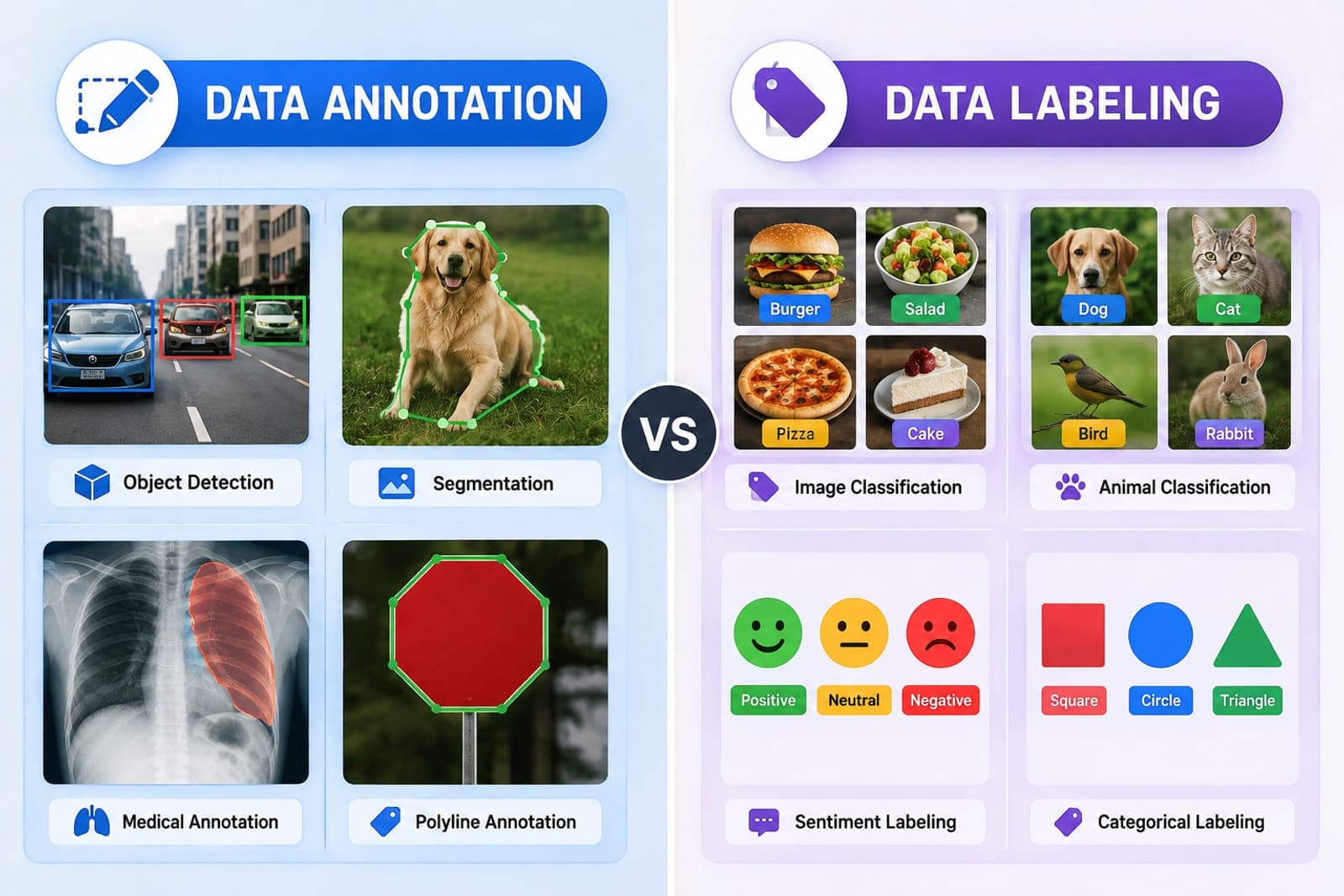
Every article on this question gives you the same answer: annotation is broader, labeling is a subset. That is correct. It is also close to useless the moment you have to price the work, staff it, or write an acceptance clause.
Direct answer
Data labeling assigns a category or tag to a sample, answering "what is this." Data annotation is the broader practice of adding any structured metadata that makes raw data interpretable to a model, which includes labeling but also spatial regions, relationships, attributes, and temporal boundaries. All labeling is annotation; not all annotation is labeling.
That is the textbook answer and it is accurate. The rest of this article covers the part that actually affects your project, which is that breadth is the wrong axis to organize work around.
Why the standard distinction does not help you
Take two tasks that sit on opposite ends of the usual breadth spectrum.
Task A: tag 50,000 product photos as "in stock" or "out of stock." That is labeling by any definition. Simple, categorical, one tag per image.
Task B: draw bounding boxes around every vehicle in 50,000 street scenes. That is annotation, because it adds spatial structure rather than a single class.
Now ask the questions that determine whether a project succeeds: who can do this work, what does it cost per unit, how do we know it is right, and what happens when two workers disagree?
For both tasks the answers are nearly identical. Both can be done by a trained annotator following a written guideline. Both can be priced per item. Both can be measured with straightforward agreement metrics. Both settle disagreements by rereading the guideline. The breadth distinction told you they were different categories of work. Operationally they are the same job.
Now take Task C: mark the moment a robot's grasp begins and ends in a teleoperated episode, and score whether the demonstration succeeded. Formally this is annotation, same category as Task B. In practice it shares almost nothing with it. Two qualified people will disagree about the boundary, the guideline will not settle it because the ambiguity is in the physical world rather than the taxonomy, and resolving it requires someone who understands the task and the hardware to replay the episode.
The reframe
The axis that predicts cost, workforce, and quality method is not how much information is added. It is how a disagreement gets settled. Tasks where the guideline is the final authority behave one way. Tasks where a human expert is the final authority behave another. Tasks where you have to go back to the source data behave a third way, and cost several times more than either.
The adjudication test
Three questions, asked about any data task before you scope it. The answer tells you more than the annotation-versus-labeling label ever will.
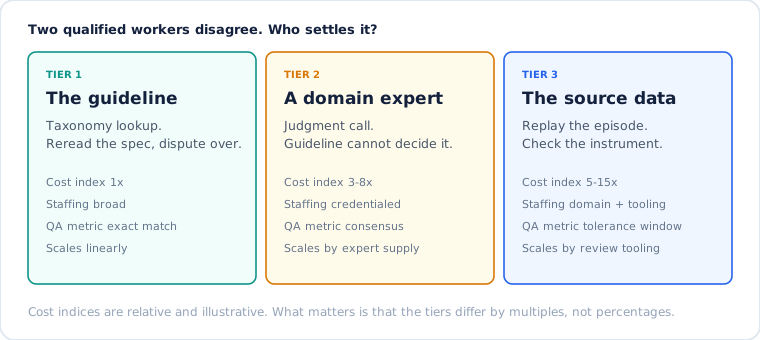
Both "labeling" and "annotation" tasks appear in all three tiers. That is why the conventional distinction fails to predict anything useful about a project.
The guideline settles it
The work is a lookup against a defined taxonomy. Spam or not spam. Cat or dog. Vehicle bounding box. Sentiment positive, negative, or neutral. If two people disagree, one of them misread the spec.
What this means operationally: price per item, staff broadly, measure with exact-match agreement, and expect the cost to scale roughly linearly with volume. This is the tier where outsourcing economics are strongest and where automation assists most.
A domain expert settles it
The ambiguity is real and the guideline cannot resolve it, because resolving it requires knowledge the guideline does not contain. Is this radiology finding clinically significant. Is this contract clause a material deviation. Does this pedestrian intend to cross.
What this means operationally: you need credentialed reviewers, consensus-based quality rather than single-pass, and a named adjudication authority with an SLA. Cost per unit runs several times Tier 1 and scales with expert availability rather than with headcount.
Only the source data settles it
Neither the guideline nor an expert opinion is sufficient; you have to go back to the underlying signal. Where exactly did this action begin in the trajectory. Did calibration drift between these two sessions. Did the grasp actually succeed or did the object shift after release.
What this means operationally: reviewers need replay tooling and hardware context, agreement must be measured against a tolerance window rather than exact match, and per-unit pricing fits badly because units vary enormously in review time. This is the tier most physical AI data sits in, and the tier most generic annotation vendors have never encountered.
Mapping common tasks to tiers
| Task | Conventional name | Adjudication tier | What that changes |
|---|---|---|---|
| Tag email as spam or not spam | Labeling | Tier 1 | Per-item pricing, broad staffing, exact-match QA |
| Bounding boxes on vehicles | Annotation | Tier 1 | Same as above despite the "annotation" name |
| Pixel-level semantic segmentation | Annotation | Tier 1, high effort | Still guideline-settled; cost is time, not judgment |
| Named entity recognition, general domain | Annotation | Tier 1 | Guideline-settled once the taxonomy is stable |
| Clinical significance of a finding | Annotation | Tier 2 | Credentialed reviewers, consensus QA, expert SLA |
| Pedestrian intent in a driving scene | Annotation | Tier 2 | Real ambiguity; measure agreement, not correctness |
| Action boundaries in a robot episode | Annotation | Tier 3 | Replay tooling, tolerance windows, hardware context |
| Episode success and trajectory quality | Annotation | Tier 3 | Cannot be judged from video alone; needs state data |
| Calibration validity across a batch | Annotation | Tier 3 | Adjudicated against logged calibration records |
Notice that the "conventional name" column has almost no predictive power over the two columns that matter. That is the case for retiring breadth as your primary organizing distinction.
Where the terms genuinely do matter
None of this means the vocabulary is useless. There are three situations where getting the words right has real consequences.
Writing a scope of work
"Annotate 50,000 images" is not a scope. Vendors price ambiguity as risk, so vague scopes reliably cost more than precise ones. Specify task type, unit of work, adjudication authority, agreement metric with tolerance, and acceptance threshold.
Comparing quotes
Two vendors quoting "annotation" may be pricing entirely different work. One assumes single-pass Tier 1 output; the other assumes consensus review. The cheaper quote is not cheaper, it is a different product.
Hiring and team design
A Tier 1 operation needs throughput management. A Tier 2 or 3 operation needs domain-credentialed reviewers and someone who owns adjudication. Staffing a Tier 3 problem with a Tier 1 org chart is a common and expensive mistake.
Setting quality thresholds
"99% accuracy" means something in Tier 1 and almost nothing in Tier 2 or 3, where there is no single correct answer to be accurate against. Those tiers need agreement metrics and defined tolerances instead.
The physical AI case, in detail
This is the part of the topic that most published comparisons skip entirely, and it is where the conventional framing breaks hardest.
In image annotation the artifact is static. A frame either contains a pedestrian or it does not, and the box is drawn once. In robot demonstration data the artifact is a time series: synchronized camera streams, joint positions and velocities, commanded actions, gripper state, and force readings, all running together across an episode.
What gets annotated is therefore different in kind:
- Temporal boundaries. Where a sub-action starts and ends within a continuous trajectory. There is no pixel edge to snap to.
- Task success. Whether the episode achieved the stated goal against defined criteria, which is not the same as whether the arm moved.
- Trajectory quality. Whether the motion was smooth or contained the corrective oscillation typical of novice teleoperation, which degrades policy learning quietly.
- Language grounding. Natural language instructions attached to segments, where phrasing consistency across annotators materially affects what a vision-language-action model learns.
- Calibration validity. Whether the sensor calibration during this episode matched the session baseline, adjudicated against logged records rather than opinion.
Public dataset work has flagged annotation granularity as a live limitation in exactly this way: large manipulation datasets have been released with only one to three instructions per trajectory, with richer temporally grounded multi-step annotation absent. That gap is not a labeling gap. It is a Tier 3 adjudication gap, and it is why the field's most valuable remaining work in robot data is annotation depth rather than collection volume.
What this changes in practice
Ask any prospective annotation partner one question about temporal data: what tolerance window do you use for inter-annotator agreement on an action boundary, and how did you choose it? Teams who work in Tier 3 have a considered answer. Teams who do not will either say "exact match" or change the subject. It is the fastest screen we know of.
A practical way to use this
Before your next data project, run this sequence. It takes about an hour and reliably surfaces problems that otherwise appear in month three.
- ✓Write down every distinct task type in the project, separately, at the level of "one worker does this to one unit"
- ✓For each, run the adjudication test and record the tier
- ✓Sanity-check the tier by pulling ten genuinely hard examples and having two people label them independently, then seeing what it takes to resolve the disagreements
- ✓Assign an adjudication authority per Tier 2 and Tier 3 task, with a response SLA, because unanswered questions become inconsistent guesses
- ✓Choose the agreement metric per tier: exact match for Tier 1, consensus for Tier 2, tolerance window for Tier 3
- ✓Price and staff per tier rather than blending everything into one rate, or your Tier 1 volume will subsidize a Tier 3 problem until the budget runs out
- ✓Write the tier into the scope of work so vendors quote the same product
If you want the fuller treatment of what annotation covers across data types and quality frameworks, our pillar guide on what data annotation is goes wider. For the build-versus-buy question that usually follows this one, see in-house vs outsourced annotation.