
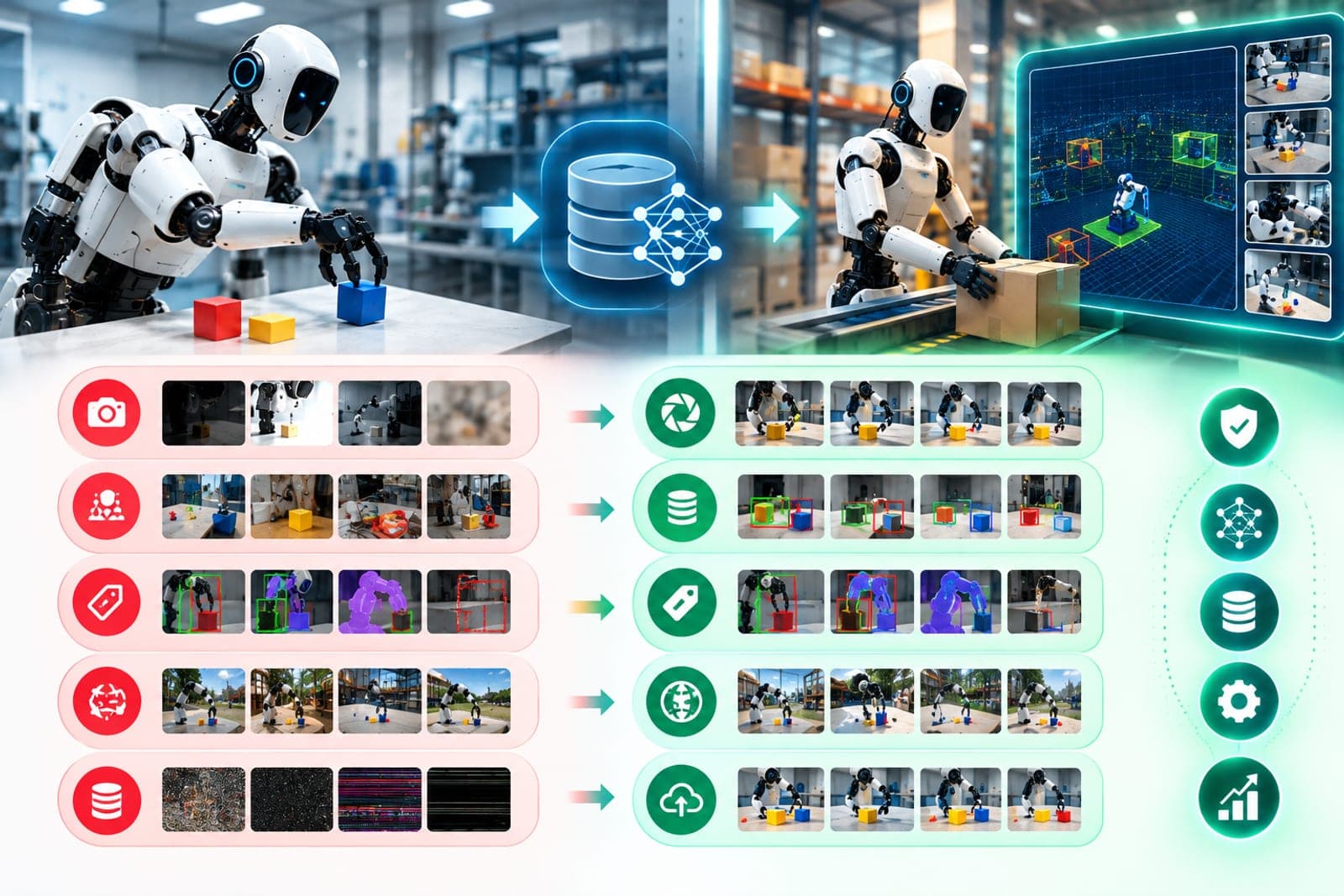
When a robot policy jitters, hesitates, or misses by a consistent few centimeters, teams usually start tuning the model. Most of the time, the cause is sitting in the data, and the symptom tells you exactly which kind of data problem it is.
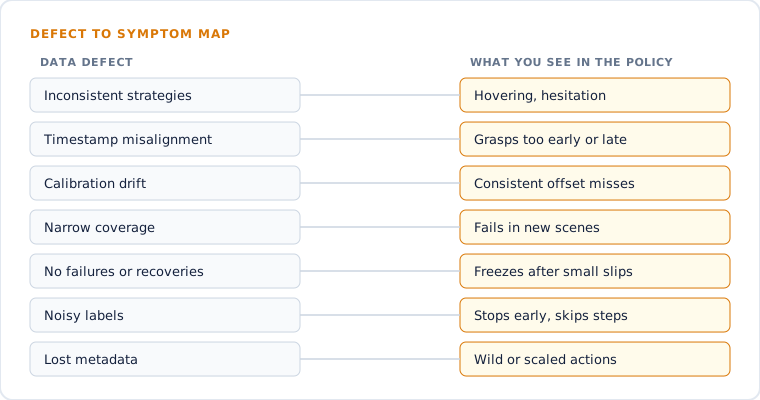
Start from the symptom you see in evaluation and trace it back to the most likely data defect before touching the model.
An ML lead at a robotics company had a strange bug. Their bin-picking policy worked smoothly in morning evaluations and got noticeably jittery in the afternoon. Same robot, same bins, same model weights. They spent a week on the model: smoothing, different action chunk sizes, a new checkpoint. Nothing helped. The cause, when they found it, was in a spreadsheet nobody had looked at. Most afternoon demonstrations in the training set had come from late, long sessions by one tired operator, recorded under the same afternoon sun that now lit the evaluation cell. The model had learned that "afternoon light" meant "wobble a bit before you grasp."
That's what physical AI data quality problems look like in practice, and it's why annotation quality decides whether a model actually works. They rarely announce themselves as data problems. They show up as model behavior.
Direct answer
The biggest data quality challenges in physical AI are inconsistent demonstrations, timestamp misalignment between sensors, calibration drift, narrow environment coverage, missing failure and recovery examples, noisy labels, and metadata lost during format conversion. Each one produces a recognizable symptom in the trained policy.
They're solved mostly at capture time: qualified operators following written protocols, synchronized and calibrated sensors checked every session, planned diversity, labeled failures, and per-episode quality scoring before data reaches training.
Why data quality matters more in physical AI than almost anywhere else
Language models can absorb a lot of messy data because they see so much of it. Robots don't get that luxury. Robot datasets are small by comparison, and imitation learning has a specific weakness: small errors compound. Stanford researchers made this the center of their work on data quality in imitation learning, defining a high-quality dataset as one that keeps the policy in familiar states at test time, and showing that inconsistent actions in the data push it out of them.
There's also direct evidence that quality can beat quantity. The AgiBot World team reported that a 236-hour subset of their standardized, human-verified data achieved higher success than roughly 2,000 hours of Open X-Embodiment data, and that their full dataset improved pretraining results by an average of 30%.
In robotics, a smaller dataset you trust beats a bigger dataset you don't. The policy will faithfully learn whatever the data says, including its mistakes.
Seven data quality challenges, and the symptoms they cause
Inconsistent demonstration strategies
Symptom: the robot hovers, hesitates, or reaches for a point between two sensible options. When operators handle the same situation differently, the policy can average those choices into a bad one. This is the action divergence problem described in the Stanford research above.
Fix: a written strategy per situation, operator qualification, and consistency tracking per operator. Our guide to human demonstrations for robot training covers this in depth.
Timestamp misalignment
Symptom: the gripper closes before it reaches the object, or after it has slid past. When camera frames and robot state are offset by even a few frames, the model learns a shifted cause and effect.
Fix: one shared clock for every stream, verified each session, with automated checks for dropped or duplicated frames. See sensor fusion in physical AI.
Calibration drift
Symptom: misses by a consistent distance in one direction. A camera that shifted slightly after maintenance makes every target appear a bit off. Worse, a batch recorded after the shift gets mixed with earlier data, and the model learns two different geometries.
Fix: log a calibration baseline per session and compare against it automatically. Treat any hardware change as a data event.
Narrow coverage
Symptom: excellent in the lab, poor at the customer site. If demonstrations all came from one room, one lighting setup, and one object set, the policy learned that room. DROID's creators collected across 564 scenes specifically because narrow data limits robustness.
Fix: a written diversity plan with coverage tracked weekly. More in generalization in physical AI.
No failures or recoveries
Symptom: the robot handles clean starts well, then freezes or flails after a small slip. If every training episode was a clean success, the policy has never seen a messy state, let alone how to get out of one.
Fix: keep failed episodes and label them clearly, and record deliberate recovery demonstrations. An NVIDIA-hosted conversion of DROID ships 16,000 failure episodes alongside 76,000 successes. Physical Intelligence's work on learning from corrections reported that this kind of experience cut failure rates by half or more on hard tasks.
Noisy labels
Symptom: the robot stops early, skips steps, or follows instructions loosely. Success flags marked inconsistently, subtask boundaries placed differently by different annotators, or vague language instructions all confuse the model. If you plan to use reinforcement learning, noisy success labels become a noisy reward.
Fix: checkable success criteria in writing, annotation guidelines with examples, and agreement checks between annotators. Deciding who does this work is its own question, covered in in-house vs outsourced data annotation. This is where a dedicated robotics annotation pass pays off.
Metadata lost in conversion
Symptom: actions that are wildly too large, too small, or in the wrong frame. Converting between formats can silently drop units, action normalization statistics, coordinate frames, or camera intrinsics. Many training pipelines normalize actions using dataset statistics, as the Mobile ALOHA co-training setup describes, so wrong statistics mean wrong actions.
Fix: deliver data in the training pipeline's native format, such as RLDS, HDF5, Zarr, or LeRobot, with calibration files, the robot URDF, and action-space documentation attached to every episode.
Diagnosis cheat sheet
| Symptom in evaluation | Most likely data cause | Quick check |
|---|---|---|
| Hovering or hesitating before grasp | Inconsistent strategies across operators | Cluster grasp approaches per operator |
| Gripper closes too early or late | Timestamp offset between streams | Plot gripper command against contact frame |
| Misses by a fixed distance | Calibration drift mid-dataset | Compare calibration logs across batches |
| Works in lab, fails on site | Narrow scene coverage | Tally scenes and lighting in training data |
| Freezes after small mistakes | No failure or recovery data | Count labeled failures and recoveries |
| Behavior changes by time of day | Confounded capture conditions | Cross-tab operator, session length, lighting |
| Actions far too large or small | Lost normalization or units | Recompute action stats from raw data |
Where to catch each problem, and what it costs
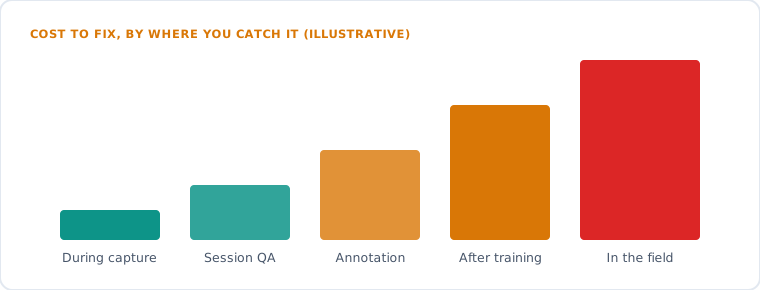
The same defect costs a retake if caught during capture and a customer escalation if caught in the field. Quality checks belong as early as possible.
This is the economic argument for capture-time quality control. A drifted camera noticed during a session costs a recalibration and a few retakes. The same drift noticed after training costs a lost run, a relabeling job, and weeks of debugging, like the afternoon jitter at the top of this article.
Synthetic data doesn't exempt you, either. Pipelines that multiply a few human demonstrations into many synthetic ones, like NVIDIA's GR00T blueprint, also multiply any flaw in those seed demonstrations. A quality problem at the seed becomes a quality problem at scale.
What we see in the field
The teams with the cleanest data aren't the ones with the most elaborate review process at the end. They're the ones that score every episode as it comes in. Our physical AI data collection work uses an Episode Integrity Score across task success, trajectory smoothness, calibration drift, annotation consistency, and environment coverage, and failed or borderline episodes go to replay review rather than the trash. Combined with session-length limits and operator qualification, that catches most of the defects in this article before they ever reach a training run.
A data quality checklist for physical AI teams
- •Written task protocols with one strategy per situation and checkable success criteria.
- •Operator qualification before contribution, and consistency tracking per operator.
- •Session-length limits so fatigue doesn't creep into the data.
- •Shared clocks, per-session calibration baselines, and automated drift and frame-drop checks.
- •A diversity plan covering scenes, lighting, objects, and operators, tracked weekly.
- •Labeled failures and recovery demonstrations kept, not deleted.
- •Annotation guidelines with examples and inter-annotator agreement checks.
- •Delivery in the training pipeline's native format with full metadata.
- •Capture metadata (operator, session, time, lighting) stored so confounds can be found later.
That last item would have saved our ML lead a week. With operator and session time recorded per episode, the afternoon pattern would have shown up in a single cross-tab. They rebalanced the data, recaptured a few sessions under the protocol, and the jitter disappeared.
For the bigger picture on choosing and auditing data sources, read our guide to physical AI datasets, and for how clean data flows into a model, see physical AI training. If you'd like data that arrives already scored and documented, the Gamasome team can help.