
Trend pieces about robotics tend to age badly because they make predictions nobody can check. This one ties each shift to a signpost you can watch, and to the practical change it forces on teams building robots today.
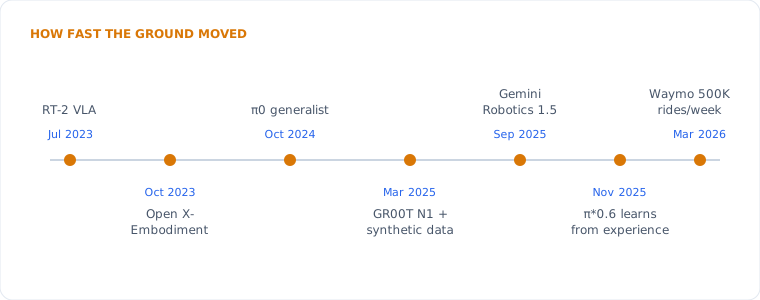
Selected public milestones. Each one changed what "state of the art" meant for robot training data.
A CTO at a humanoid startup told us her 2027 roadmap had been rewritten three times in twelve months. Not because her team was slow, but because the ground kept moving: new open models, new synthetic data tools, a competitor's warehouse pilot going live. Her real question wasn't "what's the next big thing?" It was "which of these changes should I actually build around?"
That's the right question. So here are six shifts we think will define physical AI over the next few years, each paired with a signpost you can check and the concrete change it forces on teams.
The short version
The future of physical AI is moving from robots trained once on demonstrations to robots that keep learning from deployment, run shared models across many bodies, separate high-level reasoning from motor control, and train on a mix of real, synthetic, and human video data. Humanoids are moving from demos into paid work, and robotaxis are already showing what scale looks like.
The bottleneck is shifting from model architecture to data operations: who can capture, correct, and recycle real-world experience fastest.
Six shifts reshaping robotics
Robots that learn from their own deployment
For most of the last decade, robot policies were trained on demonstrations, frozen, and shipped. Mistakes in the field became support tickets. That's starting to change.
In late 2025, Physical Intelligence described Recap, a method that combines demonstrations, expert corrections, and reinforcement learning on the robot's own experience. Applied to its π*0.6 model, the company reported that this more than doubled throughput on some of the hardest tasks, such as folding varied laundry and making espresso, and cut failure rates by half or more.
Signpost to watch: commercial vendors publishing improvement curves from deployed fleets, not just launch-day success rates.
What it changes for you: intervention and correction data become a first-class asset. If your teleoperators fix a stuck robot and nobody records it, you're throwing away your most valuable training signal. More on this in reinforcement learning in physical AI.
One brain, many bodies
The old assumption was one model per robot. The new bet is a shared model that adapts to many embodiments. Google DeepMind reported that with Gemini Robotics 1.5, a task learned on an ALOHA 2 rig transferred to a Franka bi-arm and to Apptronik's Apollo humanoid without retraining.
Signpost: hardware companies licensing a third-party robot brain rather than training their own from scratch.
What it changes: your proprietary advantage moves from "we have a model" to "we have the data for our specific tasks and sites." Calibration metadata and consistent action spaces matter more, because cross-embodiment training only works when each body's data is precisely described.
Reasoning splits from motor control
DeepMind's Gemini Robotics 1.5 release paired an action model with Gemini Robotics-ER 1.5, a separate embodied reasoning model that plans multi-step tasks and hands execution to the action model. DeepMind reported state-of-the-art results across 15 robotics benchmarks for the reasoning model. Engineers have raised a fair concern that the split could add latency.
Signpost: production robots running a slow "planner" and a fast "controller" as separate, swappable components.
What it changes: datasets need richer language and subtask labels. A planner learns from "first open the drawer, then pick the red cup," not just from raw trajectories.
Synthetic data becomes a multiplier, not a substitute
Simulation can now generate robot trajectories at absurd speed. NVIDIA reported generating 780,000 synthetic trajectories in 11 hours, equivalent to about 6,500 hours of human demonstration, and a 40% performance gain when that was mixed with real data.
The contrarian read: this makes real data more valuable, not less. Synthetic pipelines need a real seed, physics-valid assets, and real-world validation. Teams that bet on "simulation only" keep running into the gap between how a cloth folds in a physics engine and how it folds on a table. We explore the simulation side further in how AI is transforming industrial simulation.
Signpost: published ratios of synthetic to real data in commercial model training.
Human video becomes real training data
The internet is full of people doing things with their hands. Turning that into robot skill has been hard because human video has no robot actions in it. Physical Intelligence published research in December 2025 showing that transfer from human video to robot tasks emerges as robot foundation models scale with diverse pretraining.
Signpost: egocentric capture programs (head and wrist cameras on human workers) becoming a standard line item in robotics budgets.
What it changes: the line between "human data" and "robot data" blurs. Capture rigs that record a human's hands, head pose, and tool motion in sync start to look like robot data collection. We break this down in video and motion data in physical AI.
Humanoids move from demos to billable hours
Agility Robotics' Digit has moved more than 100,000 totes at a GXO site under a Robots-as-a-Service model. Goldman Sachs Research projects the humanoid market could reach $38 billion by 2035, with a base case of more than 250,000 humanoid shipments in 2030, almost all for industrial use.
Not everyone is convinced. A January 2026 Talking Logistics column argued that humanoid forecasts are inflating faster than deployments. We think both views can be true: the forecasts are aggressive, and the paid hours are real. The tell will be utilization data, not unit sales. For who's building the data layer behind this push, see our list of physical AI data collection companies.
Meanwhile, robotaxis are the template for what scale looks like. Waymo crossed 500,000 paid rides a week in March 2026, a level that took well over a decade of real-world data collection to reach.
Six shifts, six signposts
| Shift | Signpost to watch | What it means for data teams |
|---|---|---|
| Learning from deployment | Vendors publishing fleet improvement curves | Log every intervention and correction |
| One brain, many bodies | OEMs licensing third-party robot models | Precise calibration and action-space metadata |
| Reasoning split from control | Separate planner and controller in production | Language and subtask labels on every episode |
| Synthetic as multiplier | Disclosed synthetic-to-real training ratios | Physics-valid sim assets plus real seed data |
| Human video as training data | Egocentric capture in robotics budgets | Synced head, hand, and tool capture rigs |
| Humanoids in paid work | Utilization and uptime, not unit sales | Site-specific data for each deployment |
The bigger pattern: the bottleneck keeps moving
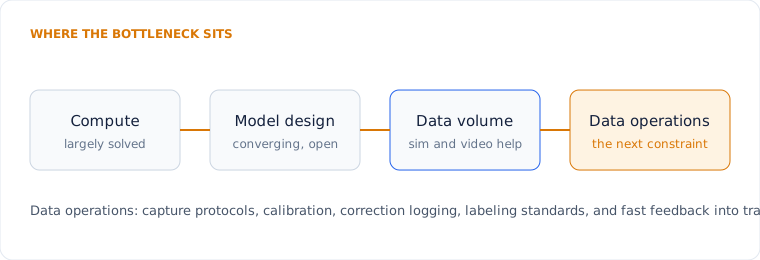
As compute and model design commoditize, the scarce skill becomes running real-world data loops well.
Look at the six shifts together and they point the same way. Open models are converging. Compute keeps getting cheaper. Synthetic data adds volume. What stays hard is the operational work of turning messy physical reality into clean, consistent, correctly labeled training signal, and doing it continuously as robots deploy.
The next physical AI moat won't be a model. It will be a data loop that runs faster than a competitor's.
What we see in the field
The teams that adapt fastest treat data capture like a production line, not a research project. They version their capture protocols, track operator consistency, and log calibration so a batch recorded in March is still usable in September. In our teleoperation programs, the same pipeline that records initial demonstrations also records corrections later, so nothing has to be rebuilt when a team moves from imitation learning to learning from experience.
What to build now
Back to the CTO with the rewritten roadmap. Our advice was to stop trying to predict which model would win and invest in what every scenario needs:
- •A capture pipeline that records demonstrations and corrections with the same schema.
- •Calibration and action-space metadata strong enough for cross-embodiment training.
- •Language and subtask labels on episodes, ready for planner-style models.
- •A small set of physics-valid simulation assets for your highest-value tasks.
- •A plan for egocentric human capture where robot time is the constraint.
Those investments pay off whichever trend wins. For a grounded view of where physical AI already works today, see our ranking of physical AI use cases, and for the skill that ties it all together, read about generalization in physical AI. When you're ready to build the data loop, the Gamasome physical AI data collection team can help design it.