
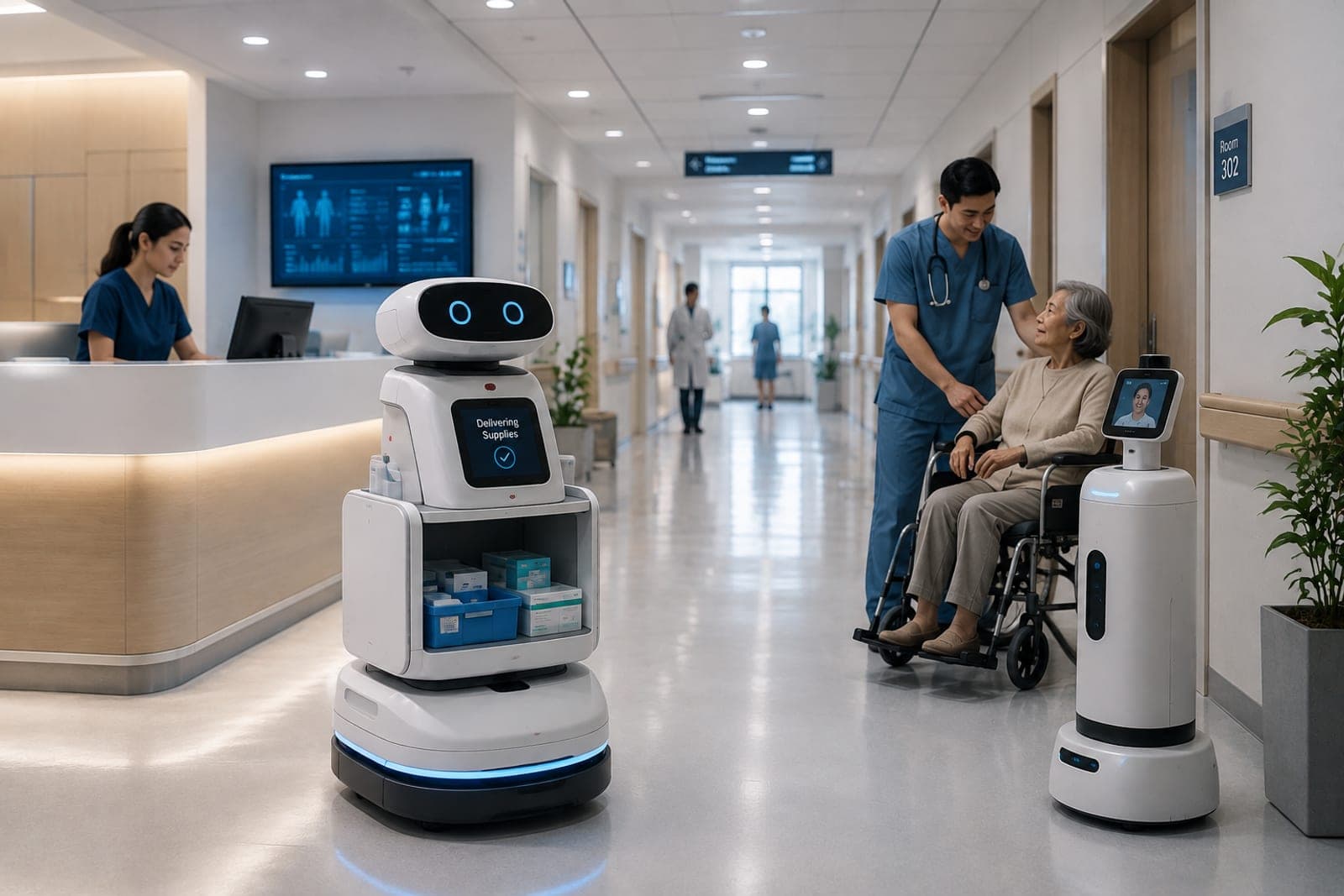
In a hospital, the hard part is rarely the robot. It is the elevator, the badge reader, the door someone forgot to hold, and the nurse who was told this thing would give her time back and has now spent eleven minutes rescuing it.
What happened at Good Samaritan
In the summer of 2023, an ICU nurse in Puyallup, Washington was introduced to a new coworker: a 300-pound autonomous robot called Moxi. Hospital leadership had brought it in to carry bloodwork, supplies, and medication so nurses could stay with patients. At the pilot's peak, fourteen robots were running the corridors of five facilities in the system.
According to reporting by Proof News, the robots struggled almost immediately. They lost their way in long hallways. They could not manage elevator buttons and called for help when they reached them. They hesitated in front of elevator doors. Nurses described the robot as one more thing to take care of on a floor that was already short-staffed. The program was eventually wound down.
It would be easy to file that under "robot fails, technology overhyped" and move on. That would be the wrong lesson, and an expensive one.
The same robot platform has, across other sites, completed more than 1.25 million autonomous deliveries across over 25 hospital facilities, and the company behind it was acquired in early 2026 specifically for that deployment footprint. The technology did not fail everywhere. It failed in buildings and workflows that were not ready for it, and it failed with staff who were never brought into the decision.
That is the real story of physical AI in healthcare, and it is a genuinely different story from logistics or manufacturing. In a warehouse, the environment was engineered for machines before robots arrived. In a hospital, the environment was engineered for a specific, highly trained species of primate operating under time pressure, and it shows.
The short version
Physical AI in healthcare covers robots and autonomous systems that sense their surroundings and act physically inside clinical settings. In practice this means four distinct families: surgeon-controlled operating platforms, autonomous delivery robots working hospital corridors, disinfection and pharmacy automation, and assistive or monitoring devices in rehabilitation and long-term care. These have very different maturity levels, very different economics, and almost nothing in common technically.
Three zones, three completely different problems
Hospitals are not one environment. A useful way to think about clinical robotics is to divide the building into zones by how much control you have over what happens in them.
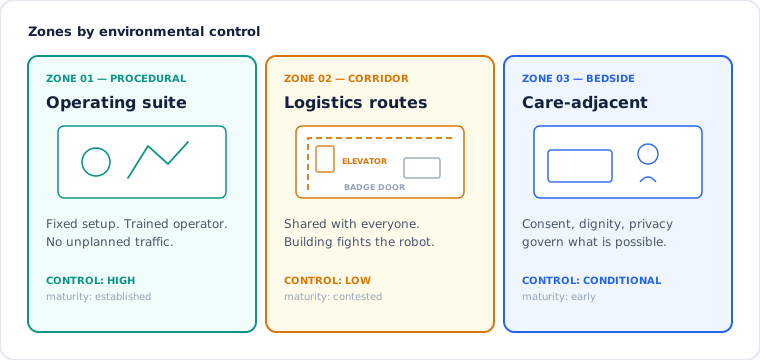
Difficulty in clinical robotics does not track technical sophistication. It tracks how much of the environment you control and how many people have to agree to your presence.
Zone 1: the procedural suite, where robotics already won
Surgical robotics is the most established form of physical AI in medicine, and it is worth understanding why. An operating room is essentially a purpose-built robot cell that happens to contain a patient. The setup is fixed, the operator is trained and credentialed, there is no unplanned foot traffic, and the robot does not navigate anywhere.
The scale is substantial. Intuitive Surgical reported that da Vinci procedures grew 18% to more than 3.1 million globally in 2025, ending the year with over 11,100 systems installed. The American College of Surgeons noted in January 2026 that more than 12 million surgeries had been performed on the platform overall. Competition has arrived too, with Medtronic's Hugo system receiving FDA clearance for urologic procedures.
Notice what these systems are not. They are teleoperated instruments with excellent ergonomics and increasingly good sensing, not autonomous agents making clinical decisions. The surgeon is in the loop at every moment. That framing is exactly why the category cleared regulatory and cultural hurdles that autonomous systems still face.
Zone 2: the corridor, where the real fight is happening
This is where hospital robotics gets interesting, and where most of the failures live.
Corridor robots handle the logistics that pull clinicians away from patients: medication runs, lab specimens, linens, supplies, equipment retrieval. The value proposition is straightforward and clinically defensible. A nurse walking to pharmacy is a nurse not at a bedside. One health system reported that its Moxi robots saved nurses over 100 million steps.
But the corridor is a genuinely hostile environment for autonomy, for reasons that have nothing to do with perception algorithms:
- Buildings are composites. Most hospitals are a tapestry of structures added across decades, connected by long hallways, elevators, and level changes. A floor plan is rarely consistent across two wings.
- Access control is designed against machines. Badge readers, keypad doors, and elevator call panels all assume a hand. Every one requires an integration or a human.
- The floor rearranges constantly. Crash carts, linen bins, wheelchairs, and cleaning equipment appear in transit paths without notice, because that is how the space actually works.
- The people sharing the corridor did not opt in. Unlike a warehouse where automation is part of the job description, ward staff usually inherit a robot decided on elsewhere.
The core asymmetry
An operating room robot has one user who was trained on it, chose to use it, and is compensated for its use. A corridor robot has hundreds of non-users who must tolerate it, none of whom were consulted, and any one of whom can end the pilot by simply refusing to help it into an elevator.
Zone 3: bedside and long-term care, where the constraints are human
The third zone includes transfer assistance, mobility and rehabilitation support, monitoring, and social or companion robots in nursing homes and home care. Technically these are often simpler than a surgical arm. Practically they are the hardest, because the binding constraint is consent, dignity, and the presence of a person who may be cognitively impaired.
This is also where the labor evidence is strongest, and it is more encouraging than most coverage suggests.
What Japan's nursing homes actually show
Japan is the most instructive case in the world for care robotics, because roughly 30% of its population is 65 or older and the government has subsidized care robot ("kaigo robot") adoption for years, creating something close to a natural experiment.
A study published in August 2026 and covered by Stanford used regional subsidy variation as an instrument to examine what robot adoption did to staffing. The findings run directly against the replacement narrative: nursing homes that adopted robots saw a significant decrease in retention problems, roughly a 28% increase in care workers, and a 39% increase in nurses. Care quality did not decline.
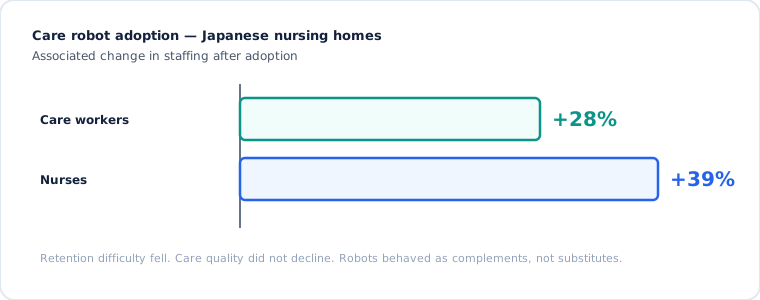
Source: research covered by Stanford's Asia-Pacific Research Center, published in Health Affairs Review, August 2026. The instrument was regional variation in Japanese government robot subsidies.
Why would robots increase employment? The most plausible mechanism is that transfer and lifting assistance reduces physical injury and burnout, which makes the job survivable for longer and easier to staff. In a labor market where care work is scarce, anything that lowers the exit rate looks like hiring.
The caveat matters too. Earlier work on the same question found that staffing gains occurred largely among non-regular employees, and Japanese research has documented plenty of care robot products that were discontinued because they did not fit real workflows. Adoption is not uniformly successful. It is conditionally successful, and the conditions are knowable.
The Ward Trust Ledger
Every robot introduced into a clinical unit opens an account with the staff who share the floor. Every interaction is either a credit or a debit. When the balance goes negative, people stop using it, and the pilot ends regardless of how good the technology is. Five entries decide the balance.
Whose time does it actually save?
A robot that saves pharmacy time but costs nursing time will be rejected by nursing, correctly. Model the time ledger per role, not per building. If the department absorbing the exceptions is not the department gaining the hours, the deployment is structurally unstable.
Who owns the rescue?
Every autonomous system gets stuck. The question is whether an assigned, resourced person recovers it or whether it defaults to whoever is nearest. Defaulting to the nearest clinician is the fastest way to burn goodwill on a short-staffed unit.
Does the building cooperate?
Elevator integration, door access, network coverage in stairwells, and charging locations are not implementation details. They are the deployment. Survey them before the robot arrives, and treat a multi-building campus as a materially harder project than a single tower.
Is it legible to patients and families?
A machine moving through a space where people are frightened and unwell carries a communication burden that a warehouse robot does not. Signage, predictable behavior, and staff who can explain it in one sentence prevent most complaints before they happen.
Can staff say no?
Units given real authority to pause or reroute a robot tend to keep using it. Units that feel a robot was imposed find ways to make it fail. Giving the floor a veto usually increases adoption, which is counterintuitive until you have watched it happen twice.
What we see in the field
The most common design mistake in clinical robotics is optimizing for autonomy percentage. A robot that completes 97% of routes unaided but hands its 3% to a charge nurse at 3am scores worse on the ward ledger than a robot at 90% with a dedicated recovery workflow. Measure interventions by who absorbs them, not by how few there are.
Where each system type actually stands
| System | Primary job | Where it stands in 2026 | Binding constraint |
|---|---|---|---|
| Surgeon-controlled platforms | Minimally invasive procedures with enhanced dexterity and visualization | Established. Millions of procedures annually and a growing competitive field | Capital cost and per-case consumables, plus training throughput for surgical teams |
| Corridor delivery robots | Medication, specimen, linen, and supply transport | Commercially deployed at scale but with visibly uneven site outcomes | Building infrastructure and workflow ownership, not navigation software |
| Disinfection and pharmacy automation | UV room disinfection, dispensing, compounding support | Mature in dedicated spaces, straightforward to justify | Room scheduling and throughput, rather than robotics capability |
| Transfer and rehabilitation assist | Lifting, mobility support, guided therapy repetition | Growing, with the strongest labor evidence of any category | Fit with existing care routines; poor fit leads to quiet abandonment |
| Monitoring and companion systems | Falls detection, engagement, cognitive stimulation in long-term care | Early and highly variable in real value delivered | Consent, privacy, and the risk of substituting for human contact |
The data problem that makes healthcare robotics different
Everything above sits on top of a constraint that teams coming from industrial robotics consistently underestimate.
In a warehouse, a camera stream is an operational asset you can record, store, and train on. In a hospital, that same stream contains patients in states of undress, visitors who never consented to anything, staff badges, whiteboards with names and diagnoses, and screens displaying protected health information. Every frame is a governance question.
This changes the engineering, not just the paperwork:
Redaction has to happen early
Face and screen redaction at the edge, before data leaves the device, is far easier to defend than a promise to redact later. It also constrains what your model can learn from, so decide deliberately rather than by default.
Simulation carries more weight
When real-world capture is restricted, physics-valid simulated environments do more of the training work. This raises the bar on asset fidelity: a corridor model that looks right but has wrong collision geometry teaches the wrong policy.
Teleoperation needs an audit trail
Remote assistance is standard practice for clinical robots when they get stuck. Every remote session touching a patient-facing space needs logging, access control, and a retention policy defined before go-live, not after an incident.
Failure data is the most sensitive
The episodes worth studying most, the near-misses and the confusing interactions, are exactly the ones most likely to involve a distressed person. Build the consent and review path for those specifically, or you will lose access to your best learning signal.
Teams that treat this as a compliance checkbox tend to end up with clean data they cannot learn from. Teams that design capture, redaction, and consent as part of the perception architecture keep the ability to improve. That decision is usually made in the first month of a program and is very hard to reverse.
If you are evaluating a clinical robotics deployment
- ✓Map the time ledger by role, and confirm the department absorbing exceptions is also gaining the hours
- ✓Name and resource the rescue owner for every shift, including nights and weekends
- ✓Survey elevators, badge doors, network dead zones, and charging locations before hardware is ordered
- ✓Run the pilot in the hardest wing, not the easiest one, because the easy wing tells you nothing about scale
- ✓Give the unit explicit authority to pause the system, and watch whether they ever use it
- ✓Define the data governance path, including edge redaction and teleoperation audit logging, before go-live
- ✓Measure interventions per hundred runs by who absorbed them, not just how many occurred
The honest outlook
Hospital robotics is not going to look like warehouse robotics, and expecting it to is the source of most disappointment in the category. Warehouses standardized the environment and then added machines. Hospitals cannot standardize the environment, because the environment is a sick person and everyone trying to help them.
What that means practically is that clinical physical AI will advance fastest where a bounded cell can be created inside the chaos: the operating suite, the pharmacy, the sterile processing department, a defined transport route with integrated elevators. It will advance slowest, and most carefully, at the bedside, which is exactly the right order given what is at stake.
The systems that succeed will be the ones designed around the ward's social reality rather than around an autonomy benchmark. That is not a softer engineering problem. It is a harder one, and it starts with capturing the right data from real clinical environments under real constraints.