
Reinforcement learning taught a quadruped to walk in minutes and a robot hand to manipulate a Rubik's Cube. It still struggles to teach a robot to fold a towel from scratch. The reason says a lot about where RL fits in physical AI today.
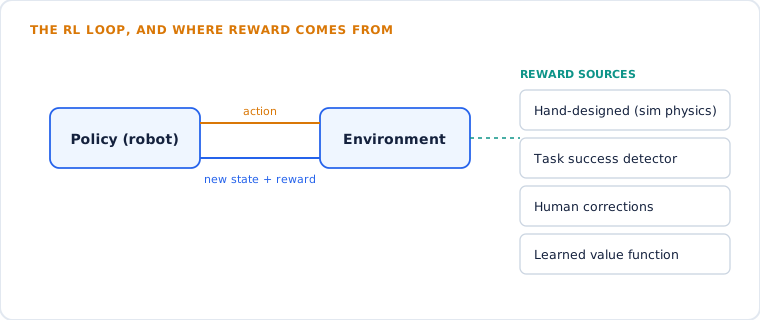
The RL loop is simple. The hard part on real robots is the reward: where it comes from and how reliable it is.
In a robotics lab, two engineers are arguing over a whiteboard. One says the team should train their laundry-folding policy with reinforcement learning: "Let the robot figure it out. It'll beat our demonstrations." The other says, "Sure, if we can wait a few years and buy a few hundred shirts." They're both right, and the way modern teams resolve that argument is the clearest picture of where reinforcement learning sits in physical AI.
The short version
Reinforcement learning (RL) trains a robot through trial and error: it tries actions, receives a reward signal for good outcomes, and gradually favors the actions that earn more reward. In physical AI, RL dominates where tasks can be simulated accurately, such as legged locomotion, and transferred to real robots with sim-to-real techniques.
For manipulation, RL is increasingly used on top of imitation learning: a robot first learns from human demonstrations, then improves from its own deployment experience and human corrections.
How reinforcement learning works on a robot
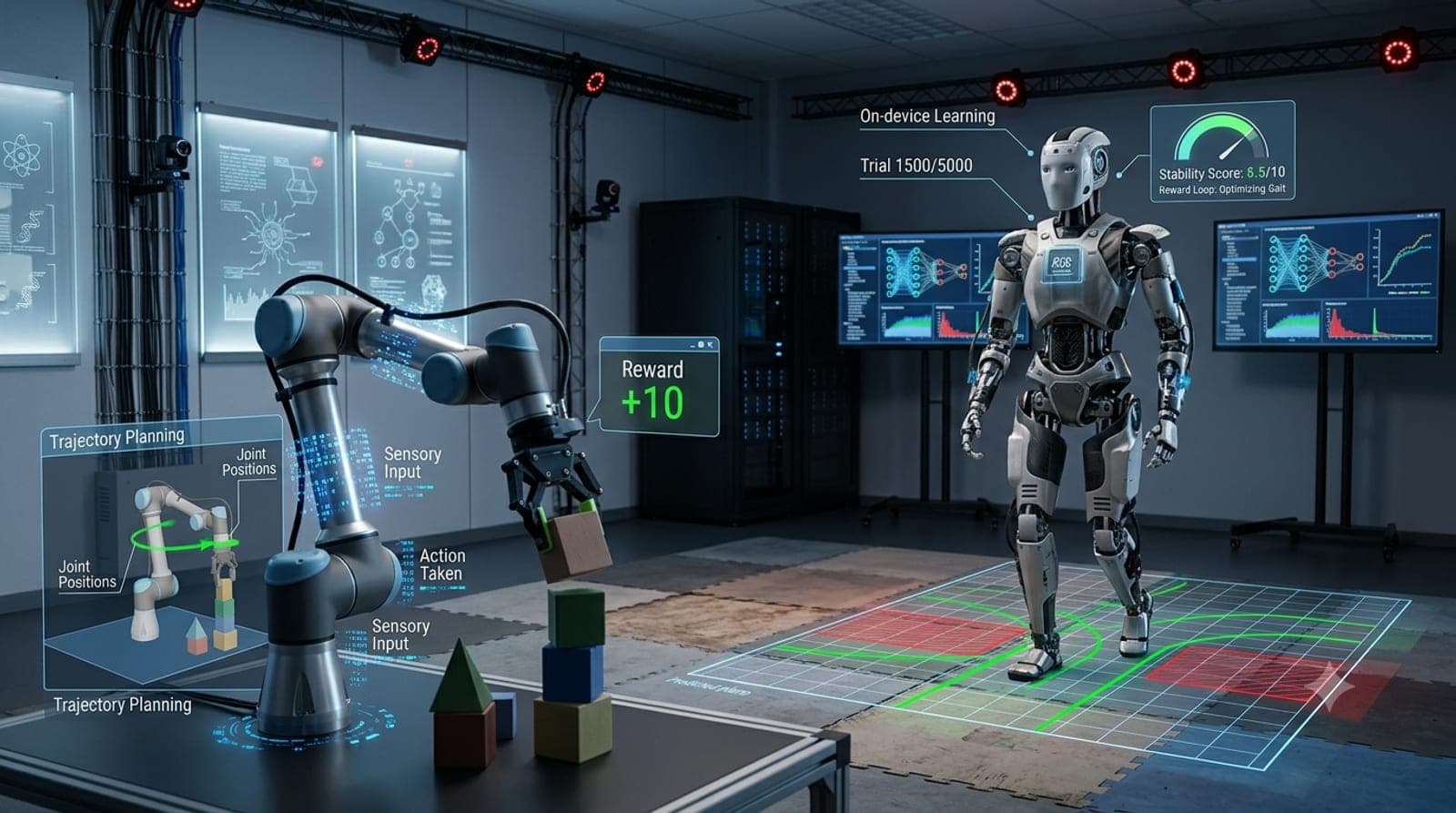
The idea is simple. An agent observes its state, picks an action, and the environment returns a new state and a reward. Over many attempts, the agent learns a policy that maximizes total reward. In a game, the reward is the score. On a robot, the reward has to be designed: distance traveled without falling, a part inserted, a shirt folded.
Why RL is hard on real robots
Games let RL agents play millions of rounds. Robots can't.
- Trials are slow and expensive. OpenAI's Dactyl hand, which learned to manipulate a Rubik's Cube, trained on the equivalent of 13,000 years of experience using 64 NVIDIA V100 GPUs and 920 worker machines. That was only possible in simulation.
- Exploration breaks things. Random actions on a real arm mean dropped objects, collisions, and wear.
- Someone has to reset the world. After every failed fold, a person has to unfold the shirt.
- Rewards are hard to define. "Folded nicely" is easy for a person to judge and hard for a program to score.
Those constraints explain almost every design decision in modern robot RL, and they're why simulation matters so much (see how AI is transforming industrial simulation).
Where RL already wins: simulated locomotion
Walking is the clearest RL success story in physical AI. The physics of a legged robot on terrain can be simulated well, rewards are easy to define (move forward, don't fall, don't waste energy), and failure in simulation costs nothing.
Researchers at ETH Zurich and NVIDIA showed how fast this can go. By simulating thousands of ANYmal quadrupeds in parallel on one workstation GPU, they trained a policy to walk on flat ground in under four minutes and on rough terrain in about twenty, then transferred it to the real robot. The Isaac Gym paper describes the tricks that made the transfer work: randomized ground friction, random pushes, observation noise, and a learned model of the real actuators.
Sim-to-real: teaching robots to expect surprises
The gap between simulation and reality is the central problem of RL in physical AI. A policy that exploits a quirk of the simulator will fail on hardware. The main defense is domain randomization: vary the simulated physics so much that the real world looks like just one more variation.
OpenAI took this further with automatic domain randomization, which keeps widening the randomization ranges as the policy improves. The payoff was striking. The Dactyl policy could still manipulate the cube with two fingers tied together and while wearing a glove, conditions it never saw in simulation. The project also drew criticism, since the solving sequence came from a classical algorithm and only the manipulation was learned, which is a useful reminder to read robotics claims carefully.
Domain randomization doesn't make simulation realistic. It makes the policy indifferent to how unrealistic simulation is.
The new pattern: RL on top of imitation
For manipulation, training from scratch with RL remains impractical for most tasks. What's working now is a hybrid: learn from human demonstrations first, then use RL to improve.
Physical Intelligence's Recap method is the clearest public example. It pre-trains a vision-language-action model on demonstrations, then adds two learning signals from the robot's own experience: expert corrections when the robot gets stuck, and reinforcement learning using a learned value function that judges which actions led toward success. The company reported that training π*0.6 this way more than doubled throughput on some of the hardest tasks, including making espresso and folding varied laundry, and cut failure rates by half or more.
The espresso example shows why RL helps here. A failure might appear at the very end of the task, but the real mistake happened much earlier, when the robot grasped the portafilter at the wrong angle. RL's job is credit assignment: tracing the outcome back to the action that caused it. Pure imitation never learns that, because demonstrations rarely contain the mistake in the first place.
Simulation-based RL is also being used to add senses. The TacCoRL preprint combined real and simulated trajectories with RL to teach a VLA to use touch feedback, reporting an average success rate of 72.5% versus a 50% baseline across four contact-rich bimanual tasks. And in industry, Agility Robotics describes Digit's skills as a blend of traditional control, teleoperated demonstrations, RL, and simulation, not RL alone.
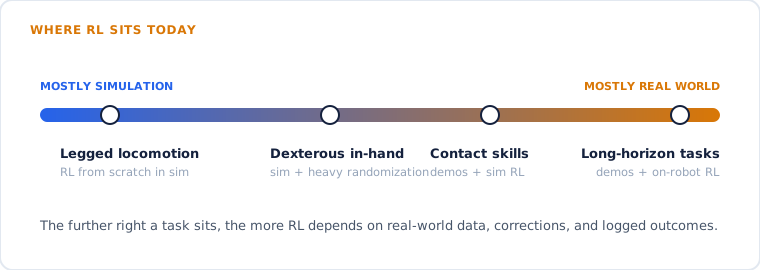
RL is not one technique in physical AI. Its role shifts from "the whole training method" to "the polishing step" as tasks get harder to simulate.
Four ways to get a reward signal
| Reward source | How it works | Best for | Watch out for |
|---|---|---|---|
| Hand-designed in simulation | Engineers write a reward from simulator state | Locomotion, balance, reaching | Policies exploiting simulator quirks |
| Task success detector | A check or model flags whether the task succeeded | Pick-and-place, insertion | Mislabeled successes poisoning training |
| Human corrections | An expert takes over and shows the fix | Recovering from mid-task mistakes | Corrections that are not logged with context |
| Learned value function | A model predicts progress toward success from each state | Long tasks with delayed outcomes | Needs labeled outcomes to learn from |
Reward is a data problem, not an algorithm problem
Here's the part that rarely makes it into RL explainers. Three of those four reward sources depend on humans labeling outcomes or providing corrections. Someone has to decide that a fold was good enough, that an insertion was seated, that a grasp was the moment things went wrong. If those judgments are inconsistent, the reward is noisy, and the robot learns the noise.
What we see in the field
When teams move from imitation learning to learning from experience, the bottleneck shifts from collecting demonstrations to logging outcomes and interventions consistently. In our teleoperation work, operators use the same rig to demonstrate, to correct a stuck robot, and to tag success or failure, so every rescue becomes a structured episode rather than a forgotten moment. That's the operational layer behind our physical AI data collection service.
A practical view from the robot floor
Back to the whiteboard argument. The lab settled it the way most do now. They collected a few hundred high-quality teleoperated demonstrations of folding, trained an imitation policy, and deployed it with an operator watching. Every time the operator stepped in, the takeover and the outcome were logged. Those episodes fed an RL fine-tuning step. Neither engineer got exactly what they wanted, and the robot got better faster than either plan alone would have managed.
If you're planning something similar, here's what to have in place before the first RL run:
- •A clear, written definition of success for each task, applied the same way by every reviewer.
- •Intervention logging that captures the robot state before, during, and after a human takeover.
- •Outcome labels on every deployment episode, including partial successes.
- •Safety limits on speed and force so on-robot exploration can't cause damage.
- •Physics-valid simulation assets if you plan to run RL in sim first.
For the full picture of how RL fits alongside demonstrations and simulation, read our guide to physical AI training. For the robustness side of the story, see how physical AI handles unpredictable environments. And if you need correction and outcome data captured properly, the Gamasome team can build that workflow with you.