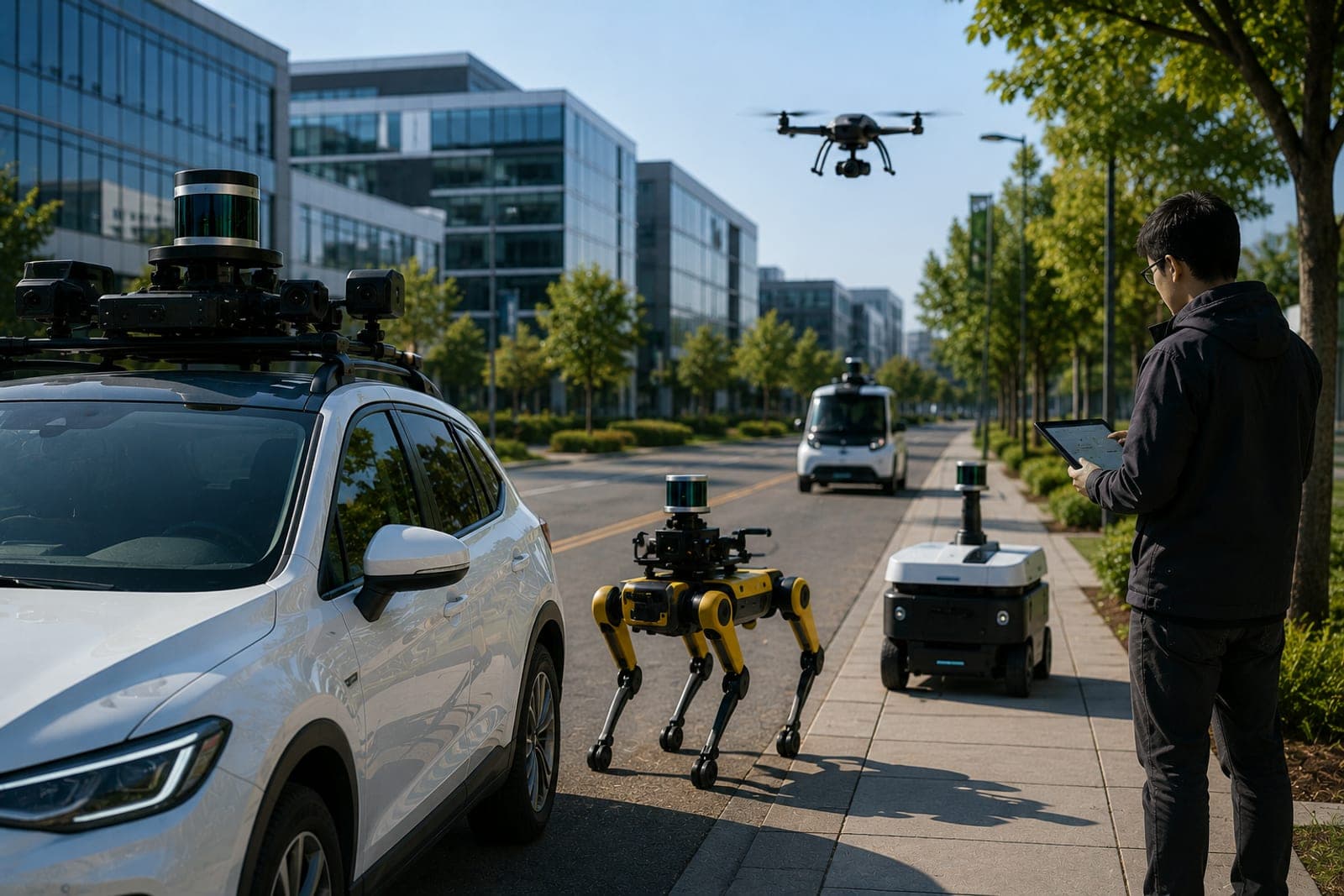

Every AI model that recognizes a pedestrian, flags a fraudulent transaction, or reaches for the right part on a shelf learned to do it from labeled examples. Here's what that labeling process actually involves, and where most explanations of it stop short.
Three different teams shipped three different models last year. A spam filter started flagging legitimate vendor invoices as junk. A radiology tool missed early-stage nodules a second-year resident would have caught. A warehouse robot reached for the wrong box in a crowded bin, three days after it had worked flawlessly in a controlled demo.
None of these failures traced back to the model's architecture. Each one traced back to a labeling queue, weeks or months earlier, that decided what "junk," "nodule," or "the right box" actually meant. That decision-making process is data annotation, and it's where most AI project problems actually begin, long before anyone opens a training script.
Direct Answer
What is data annotation?
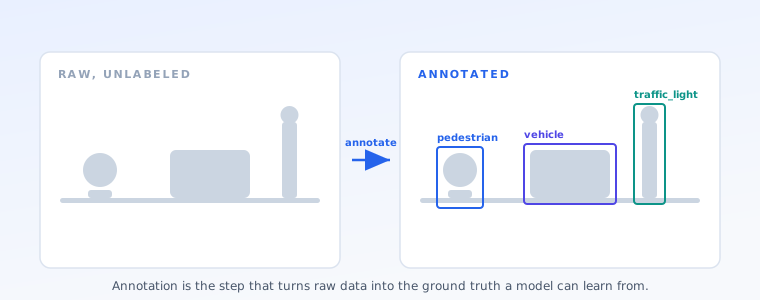
Data annotation is the process of adding labels, tags, or metadata to raw data, images, video, text, audio, or sensor readings, so a machine learning model can learn to recognize patterns in it. A model can't infer on its own that a shape in a photo is a stop sign or that a sentence expresses frustration; annotation is the step where a human, or a human-supervised system, supplies that ground truth.
A model doesn't learn what a "defect" is. It learns what your annotators decided a defect looked like, thousands of times over.
It's the foundation of supervised learning, which still powers the large majority of production AI systems in use today, from computer vision to natural language processing to the sensor-fusion models running on robots and autonomous vehicles.
Why It Matters
Model quality is a downstream effect of annotation quality
A supervised model doesn't understand a concept the way a person does. It pattern-matches against the examples it was shown, and it treats every one of those examples as ground truth, including the ones an annotator got wrong. If 5% of a training set has inconsistent boundaries around the object being labeled, the model doesn't average that out; it learns the inconsistency as part of the pattern.
This is why annotation has become one of the largest line items in AI development. The global data annotation market was valued at roughly 38.11 billion by 2035, growing at a 26.5% CAGR, according to Business Research Insights. That growth is being driven by ordinary enterprise adoption, not just frontier labs: 54% of enterprises already use annotated data in production systems, and 47% are increasing their machine learning investment year over year, per the same report.
Over 80% of enterprise data is unstructured, things like emails, images, video, and free-text notes, and none of it is usable for supervised training until it's been annotated, per Suntec's analysis of the data annotation bottleneck. That single fact explains why annotation, not compute, is often the actual constraint on how fast a team can ship a working model.
Common Confusion
Data annotation vs. data labeling: is there a real difference?
Most people use the two terms interchangeably, and in casual conversation that's fine. Where it matters is scoping a project: labeling is one specific technique inside the broader discipline of annotation.
| Data labeling | Data annotation |
|---|---|
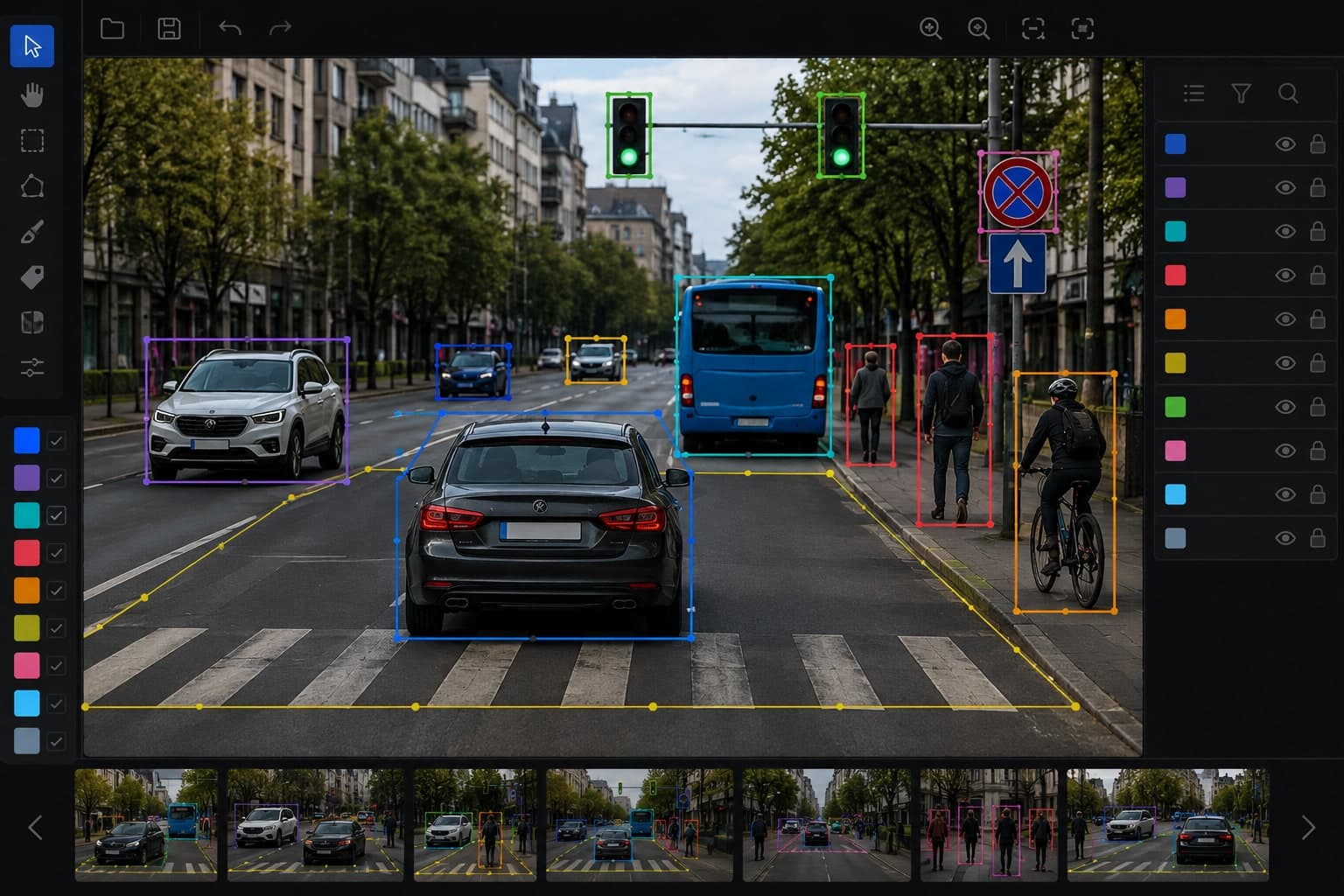
| Assigns a category to a whole data point ("this image contains a cat") | Captures category plus spatial position, relationships, or fine-grained detail ("cat, bounding box at these coordinates, partially occluded") |
| Answers "what is this" | Answers "what, where, and how" |
| Common for classification and simple tagging tasks | Required for object detection, segmentation, and any task involving spatial or temporal structure |
Distinction framing drawn from 1840 & Company's comparison and Toloka's breakdown of the two terms.
Core Types
The five data modalities annotation covers
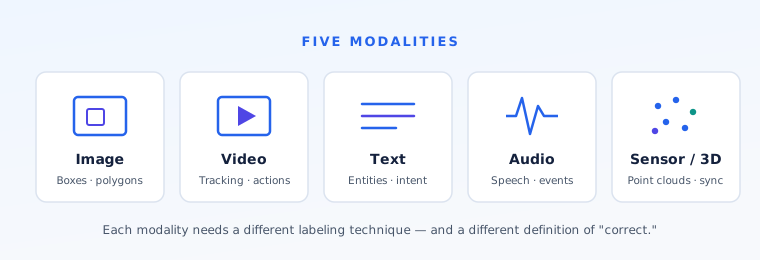
| Modality | Common techniques | Example use case |
|---|---|---|
| Image | Bounding boxes, polygon segmentation, keypoints, classification | Product recognition, medical imaging, quality inspection |
| Video | Frame-by-frame tracking, temporal action segments, event tagging | Action recognition, security monitoring, sports analytics |
| Text | Named entity recognition, sentiment tagging, intent classification | Chatbots, search relevance, content moderation |
| Audio | Transcription, speaker diarization, sound event tagging | Voice assistants, call center analytics, transcription tools |
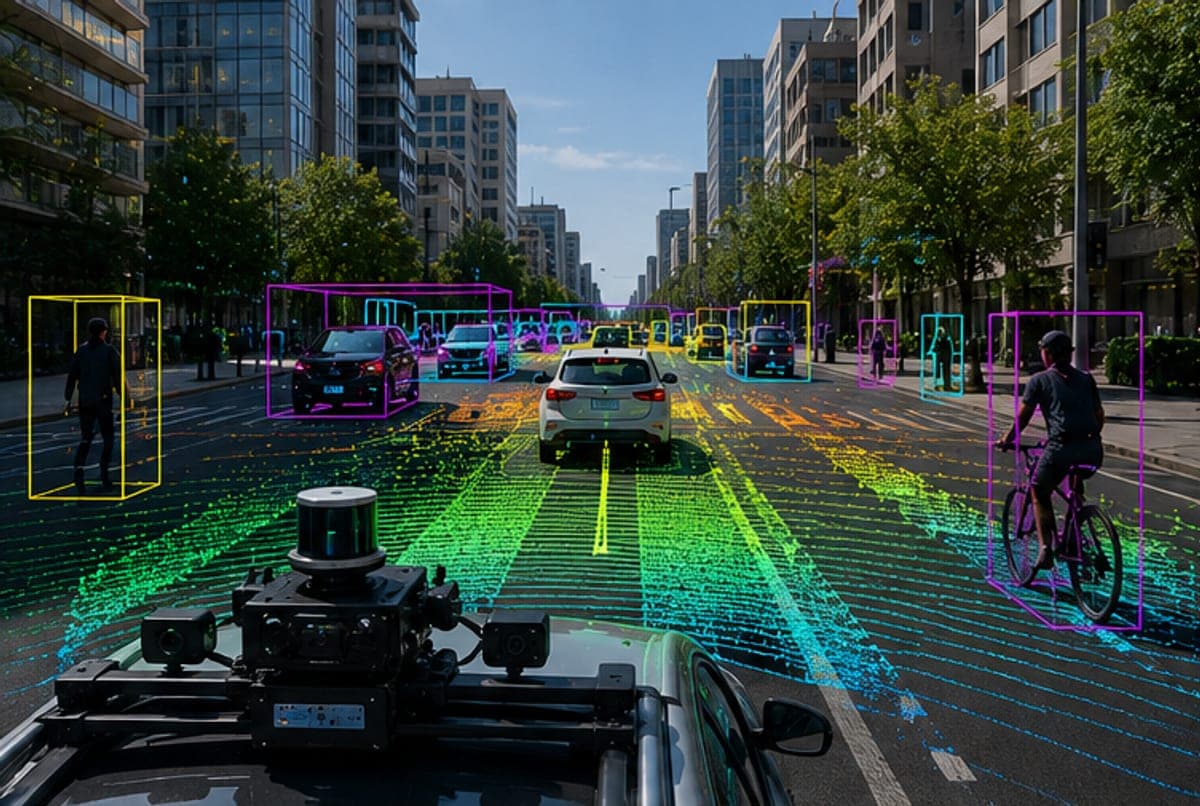
| Sensor / 3D | Point cloud segmentation, 3D cuboids, multi-sensor sync labels | Autonomous vehicles, robotics, spatial mapping |
The Process
How an annotation project actually runs
A weak label schema is the single most common cause of a failed annotation project. Everything downstream depends on getting this sequence right, in order.
- Schema design. Define exactly what's being labeled, the category set, and the rules for handling ambiguous or edge cases, before anyone starts labeling.
- Guideline writing. Translate the schema into instructions annotators can apply consistently, with positive and negative examples for the tricky cases.
- Tool & workforce selection. Choose a platform and team suited to the modality, whether that's AI-assisted pre-labeling or fully manual review.
- Annotation. Labels get applied against the agreed schema, ideally with a calibration pass before full production volume starts.
- QA & consensus. Multiple annotators' work is compared, disagreements get flagged, and low-confidence labels route to a senior reviewer.
- Delivery & versioning. The finished dataset ships in a training-ready format with a schema doc and a changelog attached.
Direct Answer
How is annotation quality actually measured?
The main metric is inter-annotator agreement, how consistently different annotators label the same data, usually measured with a statistic like Cohen's Kappa. Teams also track boundary precision on spatial tasks, gold-standard test sets where the correct answer is already known, and post-delivery model performance as a final check that the labels actually held up.
Manual, human-reviewed labeling remains the benchmark for gold-standard datasets, delivering roughly 99% accuracy on the segments annotators are trained for, according to Technavio's market analysis. That number is a ceiling, not a guarantee; it only holds when guidelines are clear and QA is actively enforced rather than assumed.
Who Does This Work
The roles behind a production annotation program
| Role | What they own |
|---|---|
| Annotator | Applies labels against the schema and guidelines |
| QA reviewer | Checks consistency, flags disagreement, enforces the quality bar |
| Domain expert | Resolves ambiguous or specialized cases requiring subject-matter knowledge |
| Project manager | Owns the schema, timeline, workforce, and delivery |
| ML engineer | Validates that delivered labels behave correctly inside the actual training pipeline |
A Practical Decision
In-house or outsourced: what the numbers actually say
In-house annotation costs more than it looks like on paper. Direct costs run 25 an hour for generalist annotators in the U.S. and 50 or more for domain experts, and that's before tooling, management time, and QA infrastructure are added in, according to SourceBae's cost breakdown. Teams that outsource report average savings of around 60% versus building equivalent in-house capability, largely because vendors amortize tooling and QA processes across many clients instead of one.
That doesn't mean outsourcing is automatically the right call. Government, defense, and any project with strict data-residency requirements often default to in-house work because of clearance and compliance constraints. The honest framing: outsourcing usually wins on cost and speed to scale; in-house usually wins on control and IP sensitivity. Most teams end up doing some of both.
Where It's Used
Data annotation across industries
Healthcare
Radiology image annotation, clinical note tagging, and pathology slide review that trains diagnostic support tools.
Autonomous vehicles
LiDAR point cloud segmentation and multi-camera object detection for perception and navigation stacks.
Retail & ecommerce
Product image tagging, catalog categorization, and visual search training data.
Finance
Document extraction, fraud pattern tagging, and entity recognition across transaction records.
Conversational AI
Intent classification, sentiment tagging, and dialogue annotation for chatbots and voice assistants.
Robotics & physical AI
Action segmentation, multi-sensor labeling, and instruction grounding for robots operating in the real world.
Where This Is Headed
The frontier most annotation guides skip: physical AI
Almost every explanation of data annotation online is built around static images and text. That covers the majority of use cases today, but it leaves out a fast-growing category where the rules change: annotation for robots and other embodied systems that have to act in the physical world, not just classify it.
A robot doesn't learn from a single labeled photo. It learns from a continuous stream of camera frames, LiDAR sweeps, force-torque readings, and joint states, all captured at once, and the annotation has to capture where one action ends and the next begins, frame by frame, synchronized across every sensor involved. Multimodal and sensor-fusion annotation is becoming essential precisely because AI is moving closer to broader real-world deployment, according to Express Analytics' review of 2026 annotation trends.
What this looks like in practice: on a recent Gamasome program capturing egocentric demonstrations for data-center hardware tasks, annotation wasn't just labeling objects in a frame. It meant holding every session to a 98%+ motion-tracking continuity threshold before the footage was even eligible for the labeling queue, because a label built on unreliable motion data isn't trustworthy no matter how carefully it's applied.
If your team is working with robot sensor data, teleoperation recordings, or simulation assets, the annotation approach that works for product photos will not transfer cleanly. We cover the full breakdown of modalities, workflow, and quality framework built specifically for this on our data annotation services for physical AI page.
What Teams Get Wrong
The mistakes that quietly sink annotation projects
Skipping schema design to "start faster"
Jumping straight to labeling without agreeing on edge cases first is the fastest way to end up relabeling the whole batch two weeks later.
Writing guidelines nobody tests
A guideline that reads clearly to the person who wrote it often falls apart the first time a new annotator hits an ambiguous case it doesn't cover.
Treating QA as optional
Skipping inter-annotator agreement checks to save time means quality problems surface after training starts, which is the most expensive place to find them.
No feedback loop from the model
Watching where a trained model actually fails is the best signal for fixing a label taxonomy. Teams that never route failures back into annotation end up re-collecting data they could have relabeled.
Where To Go From Here
Annotation quality is a decision, not an accident
The spam filter, the radiology tool, and the warehouse robot from the top of this guide didn't fail because annotation is hard in the abstract. They failed because someone treated it as a step to get through instead of a system to design. Get the schema, the QA loop, and the feedback path right, and the model built on top of it has a real chance.
If the data behind your model is robot sensor streams, teleoperation recordings, or simulation assets rather than product photos, that's a narrower and more demanding version of this problem. That's the part of the stack Gamasome works in.
Explore data annotation for physical AI · See data collection services