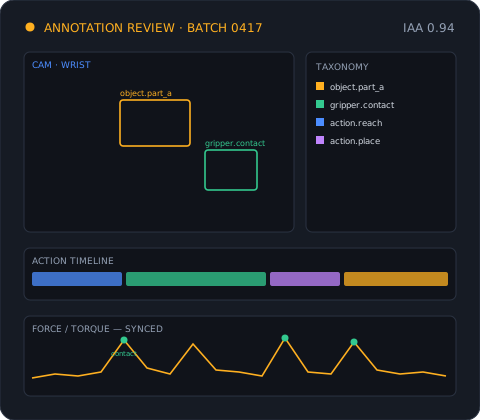
Data annotation services that
actually understand robots
A generic labeling platform can draw a box around a coffee mug. It has no idea where a robot's grasp attempt ends and its placement action begins, or how six camera feeds and a force-torque sensor need to line up on the same timestamp. Our annotators are trained on robot task semantics, not just a click-and-tag interface, so the taxonomy still holds up once a model is actually driving hardware.
Data annotation tools market, 2026–2031, Mordor Intelligence
3D/point-cloud annotation, the fastest-growing data type, driven by robotics and AV, Mordor Intelligence
Benchmark for manual labeling on gold-standard training sets, Technavio
Average savings from outsourcing vs. building an in-house annotation team, SourceBae
Direct Answer
What is data annotation for physical AI?
Data annotation for physical AI is the process of labeling robot sensor data — camera frames, LiDAR point clouds, force-torque readings, and language instructions — with the object, action, and task-level tags a model needs to learn manipulation, navigation, or interaction in the real world.
It has to stay synchronized across sensors and consistent across time, which is where it departs from tagging a single static photo. A label is only useful if it means the same thing on frame 1 as it does on frame 4,000, across every operator who touched the batch.
You need this if you're:
- ✓Fine-tuning an imitation learning or VLA policy and your raw episodes still need task labels
- ✓Training a perception stack on LiDAR, depth, or multi-camera streams for navigation or manipulation
- ✓Building instruction-following data to fine-tune GR00T, π₀, OpenVLA, or a similar foundation model
- ✓Validating simulation assets before they enter an Isaac Sim or sim-to-real training loop
Why It Matters
Bad annotation doesn't look bad. It looks like a flaky model.
Nobody ships a model on purpose with mislabeled data. The taxonomy looked fine in review. The problem shows up three weeks later, as a policy that grasps correctly in the demo environment and fails in exactly the cases the labels never captured cleanly.
Boundaries are the hard part, not boxes
Drawing a bounding box is easy. Deciding exactly where "reach" ends and "grasp" begins, frame by frame, across hundreds of operators, is where most labeling pipelines quietly lose consistency — and where a model's failure modes usually trace back to.
Sync drift breaks fusion
Robotics annotation on real learning-from-demonstration data has to account for how objects, actions, intent, motion, and failure modes interrelate, according to Shaip's breakdown of robotics annotation dimensions. If a camera label and a force-torque label reference different timestamps, that relationship is already broken before a model ever sees it.
Generic taxonomies don't transfer
A labeling schema built for street-scene object detection doesn't map onto contact events, task phases, or embodiment-specific grasp types. Multimodal robotics data has to combine RGB frames, point clouds, sensor data, and language in the same annotated window, per Encord's robotics labeling guide, which is a different problem than tagging photos.
What We Label
Annotation types built around robot sensor data, not stock photo sets
Most projects mix two or three of these, weighted by how contact-rich the task is and which model architecture is on the receiving end.
| Modality | What gets labeled | Output | Best for |
|---|---|---|---|
| Egocentric & multi-camera video | Action segments, task-phase boundaries, object states, gripper contact events | Temporal action labels, frame-level tags | Imitation learning, VLA fine-tuning |
| LiDAR & 3D point clouds | 3D bounding boxes, semantic segmentation, point-level class labels | Annotated PCD / BIN sets | AMR navigation, obstacle avoidance |
| Force-torque & proprioceptive streams | Contact events, slip detection, task-phase tags aligned to motion | Time-synced HDF5 / CSV tags | Contact-rich manipulation, insertion tasks |
| Language & instruction grounding | Natural-language task descriptions mapped to action sequences | Instruction-action pairs | VLA and instruction-following models |
| Simulation assets (USD) | Physics validation, joint definitions, collision behavior | Validated, sim-ready USD objects | Isaac Sim and sim-to-real pipelines |
Modality framing informed by Data Science Society's review of physical AI annotation vendors.
How Engagements Run
From label schema to a dataset your training pipeline actually trusts
Each stage produces something the next stage depends on. Nothing gets labeled until the taxonomy is agreed on.
Taxonomy design
Define the label schema against your task's success criteria, not a generic off-the-shelf category list.
Annotator qualification
Domain-trained reviewers pass a task-specific test batch before touching production data.
Multimodal labeling
Synchronized tagging across camera, LiDAR, force, and language streams inside one timeline.
Consensus & QA
Inter-annotator agreement is scored; disputed labels route to senior reviewers, not a majority vote.
Pipeline validation
A sample batch is run through your actual training pipeline before the full set ships.
Delivery & versioning
Formatted, versioned, and delivered with schema docs and a changelog attached.
Our Quality Framework
The Annotation Fidelity Score
Every batch is scored across five dimensions before it leaves our pipeline. This is how we catch the inconsistencies that don't show up until a model is already training on them.
Taxonomy adherence
Labels are checked against the agreed schema, not an annotator's personal interpretation of it.
Cross-sensor alignment
Camera, LiDAR, and force-torque labels are checked against a shared reference clock to catch drift.
Action boundary consistency
Start and end points of labeled actions are compared across operators for consistent placement.
Inter-annotator agreement
Every batch reports an agreement score; low-agreement labels are routed for senior review before delivery.
Pipeline transfer
A sample runs through your training pipeline to confirm the labels behave the way your model expects.
Why this exists
Manual labeling remains the benchmark for gold-standard datasets, delivering roughly 99% accuracy on the segments that matter most, according to Technavio's market analysis. That number only holds if consistency is actively measured and enforced, not assumed.
Version-controlled guidelines applied before labeling begins cut rework by roughly 74% compared with schemas developed reactively mid-project, per Precise BPO's labeling cost research, which is why taxonomy design happens before Stage 1 ends, not during Stage 3.
Expert Perspective
What most robotics teams get wrong about data annotation
Treating it like generic image tagging
A bounding box tool built for street scenes doesn't understand contact events, task phases, or embodiment-specific grasp types. Teams that route robotics data through a general-purpose labeling queue usually discover the gap only after a model trained on it underperforms in exactly the situations that mattered most.
Jumping straight to labeling
Skipping taxonomy design to "start faster" is the single most common cause of expensive rework we see. A schema built after the fact almost never matches the one the team actually needed, and relabeling a batch costs more than designing the schema properly the first time.
Ignoring synchronization until fusion breaks
Camera, LiDAR, and force-torque streams drift out of alignment gradually. It's invisible in a spreadsheet of labels and very visible the moment a fusion model tries to reconcile a contact event with the wrong camera frame.
No feedback loop from model failures
The most useful signal for improving a label taxonomy is watching where the trained model actually fails. Teams that never route those failures back to the annotation team end up re-collecting data they could have relabeled instead.
Real-World Examples
What this looks like on an actual program
Two examples from recent Gamasome engagements, not hypothetical case studies.
Egocentric demonstration capture for data-center hardware tasks
- Situation
- A multi-station human-demonstration program needed consistent, high-fidelity labels across head-mounted and gripper-mounted camera feeds plus HTC Vive Tracker 3.0 motion capture.
- Problem
- Tracking continuity has to stay above a hard quality threshold, or the motion data underneath the labels isn't trustworthy enough to annotate against in the first place.
- Solution
- Session-level QA gates were built into the annotation workflow itself, rejecting sessions before they reached the labeling queue.
- Outcome
- Sessions are held to a 98%+ tracking continuity threshold before annotation begins, so labels are built on motion data the team can actually trust.
Teleoperation data feeding VLA model post-training
- Situation
- Real-robot teleoperation captured through two input modes, a 3D mouse and VR, needed to be annotated fast enough to keep pace with an active post-training cycle.
- Problem
- Instruction-action grounding had to be precise enough for the labels to meaningfully move model performance, not just fill a dataset quota.
- Solution
- Action segments were labeled and validated against the model team's own evaluation loop before batches were signed off.
- Outcome
- The annotated data has been used to post-train both SmolVLA and Pi0.5 models on the program.
Why Gamasome
Compared to a generic annotation vendor
Generic crowdsourced platforms are built to scale simple, high-volume tasks. Robotics data asks a different question: does the label still make sense once it's inside a training pipeline.
| Capability | Gamasome | Generic annotation vendor |
|---|---|---|
| Annotator background | Domain-trained on robot task semantics | General crowdsourced workforce |
| Taxonomy design | Built against your task's success criteria | Off-the-shelf category templates |
| Multi-sensor sync | Labeled inside one synchronized timeline | Usually handled per-modality, separately |
| Feedback loop | Model failures routed back into the taxonomy | One-way delivery, no revisit |
| Delivery formats | RLDS, HDF5, Zarr, LeRobot-ready | Platform-proprietary exports |
Where This Applies
Built for teams working across manipulation and mobility
Warehouse & Logistics
Pick-place, sorting, and bin-picking action labels for AMR and fixed-arm fulfillment tasks.
Humanoid & Manipulation
Contact-rich grasp, insertion, and whole-body task labeling for humanoid and bimanual platforms.
Autonomous Mobile Robots
LiDAR and multi-camera perception labels for navigation, obstacle avoidance, and mapping.
Simulation & Sim-to-Real
Physics-validated asset review for teams bridging simulated training with real deployment.
Cost Considerations
What robotics annotation actually costs
Basic object-level labels run roughly $0.03 to $1.00 per label depending on complexity, according to BasicAI's pricing benchmarks. Multimodal, action-grounded robotics work sits at the higher end of that range, and for good reason:
Even with that added rigor, teams outsourcing annotation report average cost savings of around 60% compared with building equivalent in-house capability once hiring, tooling, and management overhead are counted, per SourceBae's cost comparison.
Delivery Formats
Delivered in the formats your pipeline already expects
RLDS
Standard TFDS-based format used across major open robot datasets and training pipelines.
HDF5
Common for ALOHA-style bimanual datasets and custom loaders that expect nested time-series structure.
Zarr
Chunked array storage suited to large-scale, cloud-native training workflows.
LeRobot format
Compatible with Hugging Face's open robot learning ecosystem for fast iteration.
Every delivery includes a label schema document, inter-annotator agreement scores, and per-batch changelogs.
FAQ
Common questions about data annotation engagements
What is data annotation for physical AI?+
It's the process of labeling robot sensor data — camera frames, LiDAR point clouds, force-torque readings, and language instructions — with the object, action, and task-level tags a model needs to learn manipulation, navigation, or interaction in the real world.
How is robotics data annotation different from standard image or text labeling?+
Standard image annotation labels a single static frame. Robotics annotation segments continuous motion into action boundaries, keeps labels synchronized across multiple sensors, and ties everything back to a task the robot is trying to complete.
What annotation output formats do you deliver?+
RLDS, HDF5, Zarr, and LeRobot-compatible structures, plus PCD or BIN for point cloud work, each with a label schema document and inter-annotator agreement scores.
How do you handle synchronization across multiple sensors?+
Every episode is time-aligned against a single reference clock before labeling starts, so a label applied to a camera frame, a LiDAR sweep, and a force-torque spike all reference the same timestamp.
What does data annotation for robotics typically cost?+
Basic object-level labels run roughly $0.03 to $1.00 per label; multimodal, action-grounded robotics work sits toward the higher end because of the extra synchronization and QA involved. Most teams still see meaningful savings versus an in-house build.
Do you offer a pilot before a full annotation program?+
Yes. Engagements typically start with a scoped pilot batch to validate the label taxonomy and quality bar against your actual training pipeline before scaling to ongoing volume.
Can you annotate and validate simulation assets, not just sensor data?+
Yes. Alongside sensor-data annotation, we validate simulation-ready assets for physics correctness, joint definitions, and collision behavior in USD pipelines built for environments like NVIDIA Isaac Sim.
How is annotation quality measured before delivery?+
Every batch is scored against our Annotation Fidelity framework: taxonomy adherence, cross-sensor synchronization, action boundary consistency, inter-annotator agreement, and pipeline transfer.