
Robots did not conquer the warehouse. The warehouse was quietly rebuilt over twenty years until a robot could survive in it. That distinction explains almost everything about where physical AI works today and where it still stalls.
From the floor
Talk to anyone who has worked a Q4 night shift in a large fulfillment center and you get the same picture. Around 2am the conveyors are still running, the tote walls are still filling, and the thing that actually determines whether the shift ends on time is not speed. It is exceptions. A carton that split. A label that scanned twice. A robot parked in an aisle waiting for a human to acknowledge it.
The picker walks over, clears it, and walks back. Ninety seconds. Multiply that by four hundred exceptions across a building and the automation savings on the spreadsheet start to look different from the automation savings on the floor.
That gap between the deck and the dock is the real subject of this article. Warehouses are genuinely the leading edge of physical AI. They also produce the most misleading headlines in the industry, because it is very easy to film a robot doing something impressive for forty seconds and very hard to film what happens in hour nine.
So here is an honest read on the logistics battleground: why it was won first, what is actually deployed at scale, what the throughput numbers look like when you divide them out, and the layer that most operators skip entirely.
The short version
Physical AI in logistics means robots and autonomous systems that perceive their surroundings, decide what to do, and act inside a live warehouse rather than following a fixed, pre-scripted path. It spans autonomous mobile robots, goods-to-person storage systems, learned piece-picking arms, and early humanoid mobile manipulators, all coordinated by warehouse execution and control software. Warehouses lead adoption not because their robots are the most advanced, but because the buildings themselves were already engineered to be readable by machines.
The warehouse won because it stopped being an open world
Most explanations for warehouse robotics start with labor economics. Those pressures are real. Warehouse turnover sits around 36% a year in most industry estimates, labor represents 50% to 70% of a distribution center's operating expense, and hundreds of thousands of transportation and warehousing roles sit open at any given moment. When you replace half your floor staff annually, every process you can make machine-executable starts to look like risk reduction rather than capex.
But labor pressure exists in construction, agriculture, elder care, and food service too. Those industries are not covered in robots. Something else made warehouses different.
The answer is that a modern distribution center is one of the most aggressively de-randomized environments humans have ever built. Consider what a warehouse gives a robot for free:
- Flat, level, load-rated floors. No stairs, no thresholds, no gravel. Localization stays stable across a shift.
- Fixed geometry. Racking is surveyed, aisle widths are standardized, and the building does not rearrange itself overnight.
- Pre-labeled objects. Every item already carries a barcode or RFID tag. The perception problem is partly solved by the supply chain itself.
- An existing digital model. The warehouse management system already knows what should be where. A robot inherits a ground-truth map on day one.
- Task decomposition. The work has already been broken into discrete, measurable units: pick, put, transport, sort, induct. Someone else did the hard job of defining what "one task" means.
That last point is underrated. In most environments, the hardest part of deploying a robot is deciding where a task starts and stops. Warehouses solved that problem for accounting reasons decades before anyone tried to solve it for robots.
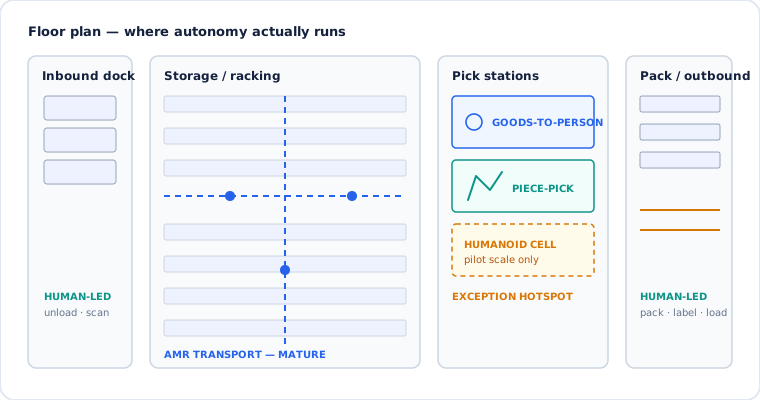
Autonomy concentrates in the middle of the building. Docks stay human because trailers, pallets, and paperwork are the least standardized part of the operation. The pick station is where the hardest perception work happens and where exception rates cluster.
What is actually running versus what is on stage
The category "warehouse robotics" hides four very different maturity levels. Confusing them is the single most common mistake in automation planning, because a board approves a budget based on a humanoid video and an operations team then has to deliver goods-to-person economics.
| System type | What it does | Maturity in 2026 | Honest constraint |
|---|---|---|---|
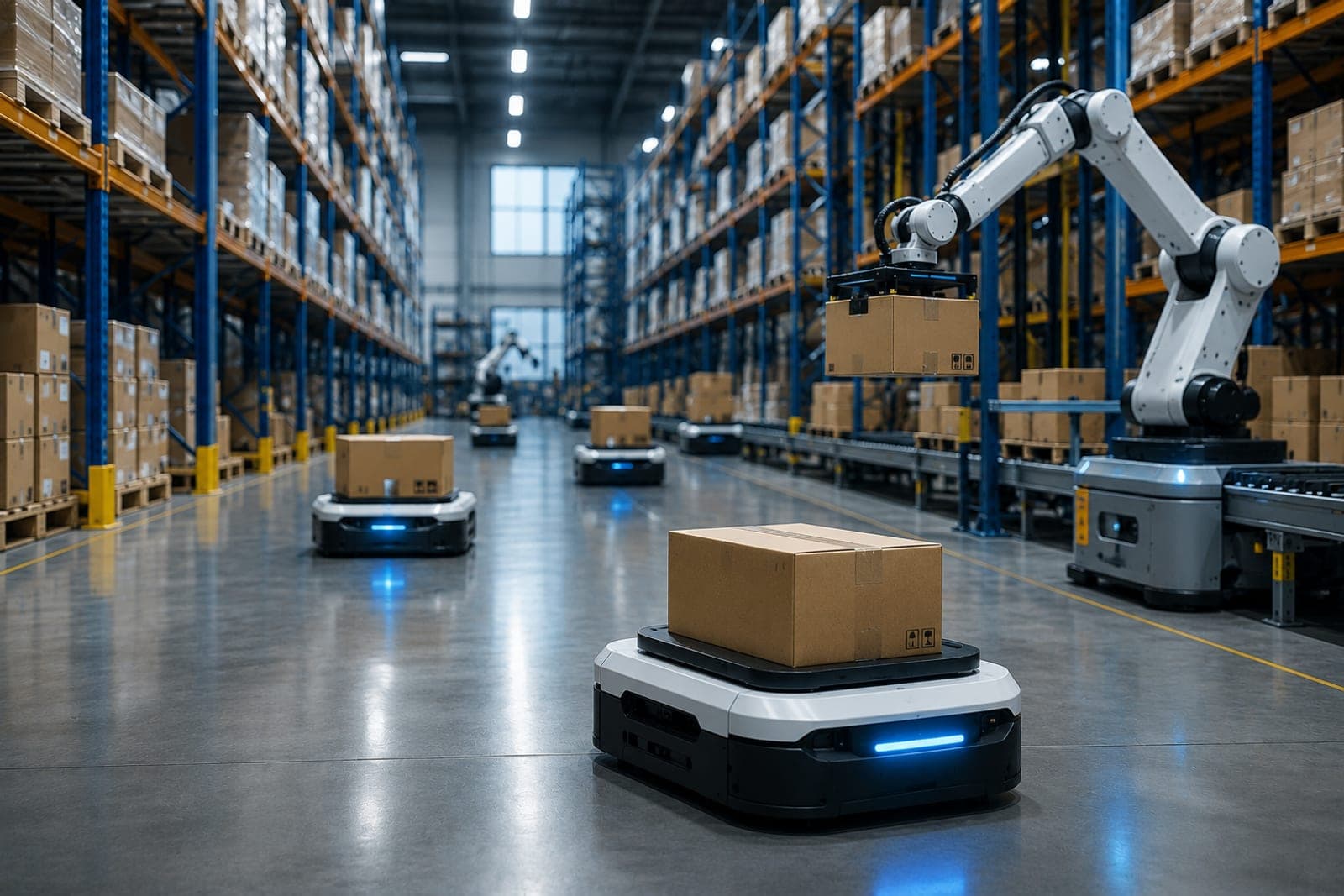
| Autonomous mobile robots — SLAM navigation, dynamic routing | Move totes, carts, and shelving between zones; guide pickers to locations | Production grade. AMRs now outsell fixed-path AGVs roughly 3 to 1 in new deployments | Throughput gains cap out once walking time is removed. The next gain has to come from picking. |
| Goods-to-person / cube storage — grid systems, shuttles, AS/RS | Bring inventory to a stationary human operator | Production grade and the density workhorse of modern fulfillment | High capex, long install, and it locks your building layout for a decade. |
| Learned piece-picking arms — vision plus grasp policy | Grasp individual, varied SKUs from bins or totes | Scaling, but performance is SKU-mix dependent | Deformables, transparent packaging, and mixed-material bins are still where pick rates fall. |
| Humanoid mobile manipulators — bipedal or wheeled, general-purpose form | Bridge the "last meter" between an AMR and a conveyor or shelf | Early commercial, single-digit sites per operator | Real work in a bounded cell, not general-purpose labor. Throughput is well below demo rates. |
The Digit number, divided out
Here is a worked example of why the maturity distinction matters, using the most publicly documented humanoid deployment in logistics.
Agility Robotics reported that Digit moved more than 100,000 totes at GXO's Flowery Branch facility in Georgia, taking totes off autonomous mobile robots and placing them on a conveyor. That is genuine commercial work under a multi-year robots-as-a-service agreement, and it deserves credit as one of the first humanoid deployments generating real revenue in a live building.
Now do the arithmetic. An independent deployment analysis spread that figure across roughly sixteen months of operation and landed at somewhere between 13 and 20 totes per hour of effective fleet output. Agility has demonstrated 66 totes per hour from a single robot at a trade show. Field performance is running at roughly a quarter of demo performance.
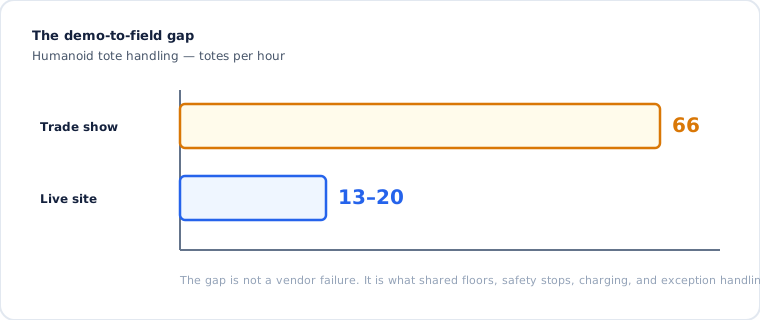
Demo throughput measures the robot. Field throughput measures the robot plus the building, the safety envelope, the charging cycle, and every interruption in between. Budget against the second number.
What we tell clients
Never accept a throughput figure without a denominator. Ask for cycles completed divided by wall-clock hours of intended operation, across a full shift, including downtime. Vendors who track their own deployments properly can produce this in an afternoon. Vendors who cannot are telling you something important.
The Warehouse Legibility Ladder
After enough field deployments you stop asking "is this robot good enough" and start asking "is this environment ready." We use a five-rung ladder to score a site before anyone quotes hardware. Each rung is a property of the building, not the robot, and every rung you skip becomes an integration cost later.
Geometric stability
Are floors flat and level to spec, is racking surveyed, and does the layout stay fixed between shifts? Localization drift is the quietest killer of AMR fleet reliability, and it almost always traces back to a building that moved.
Object determinism
How much of your SKU mix is rigid, opaque, and consistently packaged? A site running 80% cartons is a different automation problem from a site running polybags, blister packs, and loose apparel. Score your actual mix, not your catalog.
Digital ground truth
Does the WMS reflect physical reality closely enough that a robot can trust it? If your cycle-count accuracy is 94%, a robot will confidently drive to the wrong slot six times in a hundred and generate an exception every time.
Orchestration authority
Is there a single system with the authority to sequence work across conveyors, shuttles, and multi-vendor robot fleets? Without it, each additional robot adds coordination overhead rather than capacity. This is the rung most sites are missing.
Data retention
Are perception streams, robot state, and task outcomes captured together with synchronized timestamps and calibration records? If not, three years of operation produces zero training assets and every new deployment starts from scratch.
Sites at rungs one through three can deploy proven mobile and goods-to-person systems successfully today. Rung four is where multi-vendor programs succeed or quietly stall. Rung five is where a logistics operator stops being a robotics customer and starts building a compounding asset, and it is skipped almost universally.
A scenario worth learning from
Composite field scenario
Situation. A regional 3PL running three buildings for apparel and small-parcel clients adds forty AMRs to its largest site after a successful eight-robot pilot on a single zone. The pilot cut walking time by more than half and the business case looked obvious.
Problem. At forty robots, throughput improves by roughly a third of what the pilot projected. Aisle congestion appears at shift change. Pickers start waiting on robots instead of the reverse. The pilot zone had one traffic pattern; the full building has seven, and nothing is arbitrating between them.
Solution. The fix is not more robots or better robots. It is a warehouse control layer sitting between the WMS and the fleet manager, sequencing tasks by zone congestion rather than by order priority alone, plus a redesign of two cross-aisles that were never intended to carry bidirectional machine traffic.
Outcome. Throughput recovers to near the projected figure. The more valuable outcome is that the operator now measures interventions per hundred cycles per zone, which makes the next building's business case defensible rather than hopeful.
This pattern repeats constantly. Industry reporting on North American robot orders in the first half of 2026 found that unit orders rose about 2% while order value rose 7%, which tells you buyers are paying for perception, safety, and software layers rather than simply adding more units. The market has already learned this lesson. Many individual sites have not.
The layer nobody budgets for: the data coming off your floor
Here is the part that matters most for anyone building or buying physical AI, and it is almost never in the RFP.
Every robot in your building is a sensor platform. A single multi-camera picking cell running two shifts produces terabytes a week: RGB and depth streams, joint states, force readings, grasp attempts, and the outcome of every one of them. That is exactly the shape of data used to train and evaluate manipulation policies.
Almost none of it survives in usable form. The three failure modes we see repeatedly:
Unsynchronized streams
Camera frames, robot state, and WMS events are logged by three systems with three clocks. Without a shared time base, you cannot tell which action caused which outcome, which makes the whole archive untrainable.
No calibration record
Cameras drift over months of vibration. If the calibration at capture time was never logged, a batch of otherwise-good data silently degrades any model trained on it, and the cause is untraceable after the fact.
Outcomes thrown away
The single most valuable label in a warehouse is free: did the pick succeed. Most sites already have it in the WMS and never join it back to the perception stream that produced it.
Failures deleted first
Retention policies delete error events soonest because they look like noise. Failed grasps and near-misses are the highest-value training examples you will ever collect, and they are the first thing purged.
Operators who fix this end up with something a competitor cannot buy: a task-specific, environment-specific dataset that makes every subsequent deployment cheaper and faster to validate. That is the difference between renting automation and compounding it. It is also why structured data collection and annotation of robot demonstration data increasingly get scoped alongside the hardware rather than after it.
What actually happens to the people on the floor
Any honest article on this topic has to address the labor question directly, and the evidence is more mixed than either the optimistic or catastrophic framing suggests.
At the top of the market, scale is real. Amazon passed one million robots in operation and, according to reporting on internal planning documents, has modeled automating a large share of its operations over the next several years. Workers at heavily automated sites describe being moved toward the perimeter of the floor as robots take over stowing and transport.
Below that top tier, the picture is different. Roughly a quarter of warehouses worldwide have implemented any form of automation, and only about a tenth use advanced systems. Median new AMR fleet size is measured in the dozens, not the hundreds. For most operators the near-term effect is not headcount elimination. It is a change in what the job is: fewer miles walked, more exception handling, more equipment supervision, and a rising floor on the technical literacy expected of a shift lead.
Contrarian read
The scarce resource in an automated warehouse is not pickers. It is people who can diagnose why a robot stopped. Sites that treat automation as a headcount lever and cut their most experienced floor staff tend to discover this in month four, usually at 2am.
A short evaluation checklist before you scale a pilot
- ✓Sustained throughput measured across a full shift, not peak rate, with downtime included in the denominator
- ✓Human interventions per hundred cycles, tracked per zone and per failure type
- ✓Named ownership of exception recovery on nights and weekends, with an escalation path that does not depend on a vendor's business hours
- ✓A warehouse control layer with authority to sequence across every fleet you intend to run, not one fleet manager per vendor
- ✓Cycle-count accuracy high enough that the robot can trust the WMS, verified before hardware arrives
- ✓A written data retention spec: what streams, what synchronization, what calibration logging, what stays after ninety days
- ✓Pick-rate performance measured on your real SKU mix, including the ugly 15%, not on a vendor's reference bin
Where this goes next
Two things are likely over the next few years, and they pull in opposite directions.
The first is that the bounded, well-understood tasks will keep getting cheaper and more reliable. Transport and goods-to-person are close to commodity. Piece-picking is following the same curve, slower, gated by SKU diversity rather than by algorithms.
The second is that general-purpose mobile manipulation will stay harder than the coverage suggests. The humanoid deployments that work today succeed because someone carefully defined a narrow job in a prepared corner of a live site and surrounded it with conventional automation and remote support. That is a legitimate application, and it is also very far from a robot that can be pointed at any task in your building.
The operators who benefit most in this period will be the ones who treat every deployment as two projects running in parallel: the throughput project, and the data project. The first pays for itself this year. The second decides whether you are still buying capability in 2030 or building it.