
The two terms show up in the same pitch decks, job posts, and RFPs as if they were synonyms. They aren't, and treating them that way leads teams to scope the wrong data and hire the wrong partners.
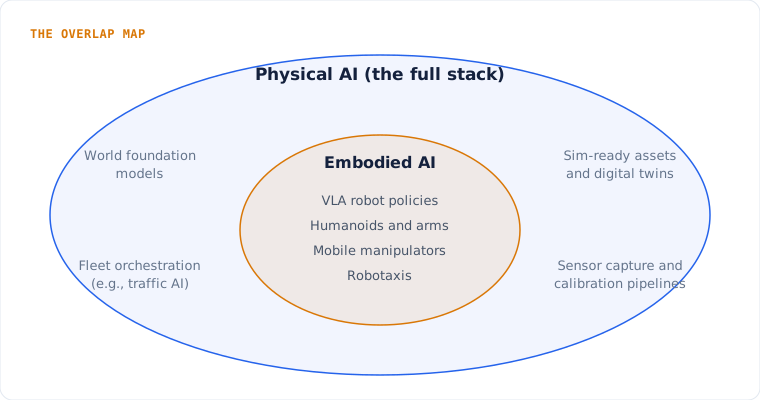
Embodied AI sits inside physical AI. The outer ring holds systems that shape the physical world without having a body of their own.
A robotics founder we worked with last year had two vendor proposals on her desk. One promised "embodied AI training data." The other promised "physical AI data infrastructure." She assumed they were quoting the same job. They weren't. The first vendor planned to record demonstrations on a single arm. The second planned calibration logging, multi-camera sync, and a simulation asset pipeline. Same budget line, very different deliverables.
That confusion is common, and it's not just semantics. The word you use shapes what you ask for, what you measure, and what your model ends up learning.
Embodied AI is an AI agent that learns and acts through a body: it perceives with its own sensors and changes the world with its own actuators. Physical AI is the broader industry stack that lets AI understand and operate in the physical world, including embodied robots but also world models, simulation, digital twins, sensor pipelines, and fleet-level systems that never touch an object themselves.
Every embodied robot is part of physical AI. Not every physical AI system is embodied.
Two terms with two very different origins
Embodied AI comes out of research. The idea is decades old in cognitive science and robotics: intelligence develops through a body interacting with an environment, not from text or images alone. In academic usage, "embodied" usually means a specific agent with a specific body, whether that body is a real robot or a simulated one in a household benchmark.
Physical AI is an industry term, and a much newer one in mainstream use. NVIDIA pushed it into the spotlight at CES 2025, when Jensen Huang introduced the Cosmos world foundation model platform and said the "ChatGPT moment" for general robotics is just around the corner. In that framing, physical AI covers robots, autonomous vehicles, and the simulation and data infrastructure needed to train them.
So one term describes an agent. The other describes an ecosystem. If you want a fuller primer on the ecosystem view, our pillar guide on what physical AI is covers the basics.
Physical AI vs embodied AI: side by side
| Dimension | Embodied AI | Physical AI |
|---|---|---|
| Core unit | One agent with one body | A stack: models, sensors, sim, data ops, fleets |
| Where the term comes from | Academic robotics and cognitive science | Industry, popularized by NVIDIA and robotics vendors |
| Typical output | Motor actions from that agent | Actions, predictions, simulated worlds, routing decisions |
| Can it exist only in simulation? | Yes, many embodied benchmarks are simulated | Simulation is a component, but the goal is real deployment |
| Main data type | Episodes from the agent's own sensors and actions | Episodes plus video, synthetic data, maps, fleet telemetry |
| Who uses the word | Researchers, ML papers, lab job posts | Executives, investors, platform vendors, buyers |
Physical AI without a body: the cases people miss
Here's where the distinction earns its keep. Some of the most consequential physical AI systems in production today don't have a body at all.
Fleet coordination models. Amazon's DeepFleet doesn't pick a single package. It is a foundation model that routes the company's warehouse robots, a fleet that passed 1 million units in 2025, and Amazon says it cuts robot travel time by about 10%. It reasons about physical space, congestion, and timing. It is physical AI. It is not embodied in any single machine.
World foundation models. Cosmos-style models generate physics-aware video of how a scene might unfold. They are used to create training and test scenarios for robots and vehicles, yet they never move anything themselves.
Simulation asset pipelines. A household drawer that looks right in a render but has the wrong hinge limits or collision mesh will quietly teach a robot the wrong lesson. Building physics-valid assets is physical AI work with zero embodiment.
If your roadmap only budgets for the robot, you've budgeted for embodied AI. Physical AI is everything that has to be true around the robot for it to work.
Where the two converge: the robot policy
The overlap is the robot policy, the model that turns camera frames, joint states, and an instruction into motor commands. This is where the most visible progress has happened in the last three years.
- Google DeepMind's RT-2 showed that pairing web-scale vision-language knowledge with robot data nearly doubled success on unseen scenarios, from 32% with RT-1 to 62%.
- Physical Intelligence trained its π0 generalist policy on roughly 10,000 hours of robot data spanning several robot configurations.
- With Gemini Robotics 1.5, DeepMind reported that a task learned on an ALOHA 2 bimanual rig transferred to a Franka bi-arm and to Apptronik's Apollo humanoid without retraining.
That last result is worth sitting with. (For a broader tour of what these models make possible, see how physical AI is powering next-generation robotics.) A policy that moves across bodies blurs the old embodied AI assumption of "one agent, one body." The intelligence starts to look like a shared physical AI layer, and each robot becomes a deployment target. The Open X-Embodiment effort, which pooled data from 22 robot types, was built on the same bet.
The Body Test: a quick way to classify any project
When a client asks us whether their project is "embodied" or "physical," we skip the definitions and ask three questions. We call it the Body Test.
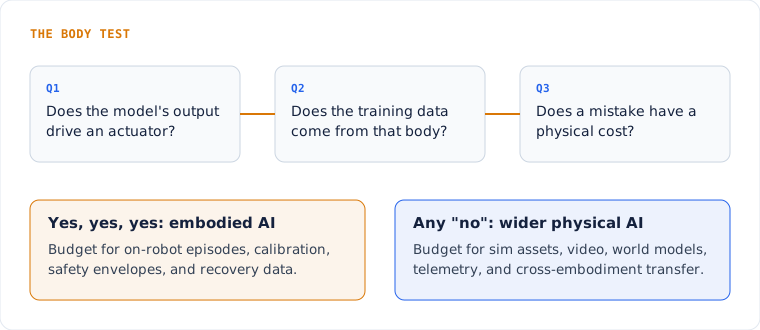
The Body Test. Three questions that tell you which kind of data and infrastructure a project actually needs.
The value isn't the label. It's what each answer does to your data plan:
- If the output drives an actuator, you need action labels that match the robot's real action space, not just video. Timing, gripper state, and joint limits all matter.
- If the data comes from a different body (a human hand, another robot, a simulator), you need a retargeting or transfer step, and you should expect some performance loss until you fine-tune on the target robot.
- If mistakes have a physical cost, you need failure and recovery examples, not just clean successes. A policy that has never seen a near-miss has no idea how to get out of one.
A buyer's view: what changes in the RFP
Back to the founder with two proposals. Her team was building a mobile manipulator for retail backrooms. Running the Body Test made the gap obvious. The "embodied" vendor would deliver episodes from one arm in one room. That answered Q1 and Q2 for a single setup, but nothing about environment variety or failure coverage. The "physical AI" vendor's plan included calibration logs, multiple store layouts, and simulated variants for rare cases. That one was priced higher per hour, but it covered the deployment she actually faced.
She ended up asking both vendors the same three questions and scoring answers instead of buzzwords. That's the move we'd recommend to anyone writing a robotics data RFP:
- Which robot, gripper, and camera layout will the data come from, and how is calibration logged?
- How many distinct environments, objects, and lighting conditions are covered?
- What share of episodes include failures, corrections, or recoveries, and how are they labeled?
- Which delivery format will the data arrive in (RLDS, HDF5, Zarr, LeRobot), with what metadata?
What we see in the field
Teams that describe themselves as "embodied AI" companies tend to under-invest in the boring parts of physical AI: synchronized timestamps, camera calibration drift, and labeling standards across operators. In our own capture programs, we hold motion-tracking continuity to 98% or better per session, because a policy can't learn from a trajectory with holes in it. Those details sit outside the "agent" but decide whether the agent learns anything useful. Our physical AI data collection work is built around exactly those details, and our field notes on data collection for robotics cover the parts most teams never see.
So which term should you use?
Use embodied AI when you're talking about a specific agent learning through a specific body: a research result, a policy architecture, a robot's skill set. Use physical AI when you're talking about everything required to get that agent working in the world: data operations, simulation, sensors, fleets, and deployment.
If you're a buyer, think in physical AI terms even if your vendor speaks embodied AI. The robot is the visible part. The stack around it is what determines whether it ships. For a closer look at that stack, read how physical AI works from perception to action, or see how it differs from text and image models in physical AI vs digital AI. When you're ready to scope data, the Gamasome data collection team can help you turn the Body Test answers into a capture plan, and our annotation team can label what you already have.