
Software teams moving into robotics expect the hard part to be the model. It usually isn't. The hard part is that the physical world doesn't have an undo button, a test environment, or a billion free training examples sitting on the internet.
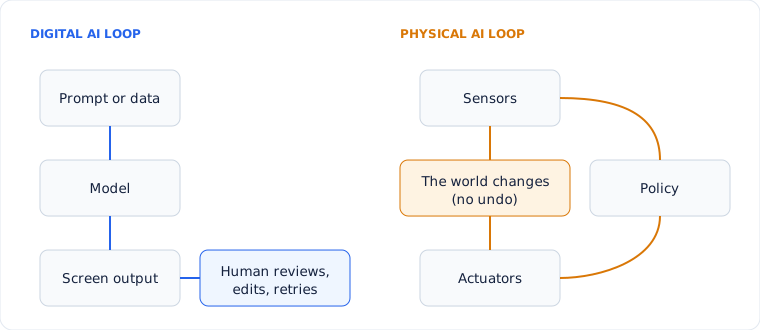
Digital AI ends at a screen where a person can review and retry. Physical AI's output changes the world, and the next input is the consequence.
A machine learning engineer we'll call Dev spent four years shipping language models. In his first week on a robotics team, he hit three surprises before Thursday. His evaluation script couldn't run overnight because every test needed a real arm and a person to reset the table. A model that scored well offline knocked a cup off the bench in its first live trial. And when he asked where the training data lived, someone handed him a list of operator shifts, not a URL.
None of those surprises were about model architecture. They were about the gap between AI that works on information and AI that works on matter.
The short version
Digital AI processes and produces information: text, images, code, predictions. Its outputs live on screens and in databases. Physical AI perceives the real world through sensors and acts on it through machines such as robots, vehicles, and drones.
The core differences are the cost of a mistake, where training data comes from, real-time constraints, the lack of an undo button, and how hard it is to test. Physical AI often builds on digital AI models, then adds everything required to act safely in the world.
The five asymmetries between physical and digital AI
Most comparisons stop at "one has a body." That's true but not very useful. These five differences are what actually change how teams build, train, and ship.
The cost of a wrong answer
When a chatbot gets a fact wrong, a person can catch it, ignore it, or ask again. When a robot gets a grasp wrong, something falls, breaks, or hurts someone. Commentators on DeepMind's RT-2 put it bluntly: unlike a language model, a robot model can't afford to hallucinate. That single fact pushes physical AI toward safety envelopes, fallback behaviors, and human oversight that digital products rarely need.
Where the training data comes from
Digital AI grew up on data that already existed: web text, image libraries, code repositories. Physical AI has to manufacture most of its data. Someone has to perform the task, record it with calibrated sensors, and label it. That's slow and expensive. The DROID dataset took 50 collectors 12 months to gather about 350 hours of robot interaction. Ego4D's 3,670 hours of first-person human video was a two-year effort by Facebook and 13 universities. Those are landmark datasets, and they're tiny next to the text that trained modern language models.
Time is not optional
A language model can take a few extra seconds and nobody minds. A robot controller that responds late is a robot controller that's acting on a world that has already moved. Physical AI has to work within the control rate of the machine, which is why planning and motor control are often split into separate models running at different speeds.
Errors compound instead of resetting
Each digital AI query is mostly independent. In physical AI, every action changes the next observation. Research on imitation learning describes how small action errors push a robot into states it never saw in training, where it makes bigger errors. Stanford researchers framed data quality itself around this state distribution shift and compounding error. Digital AI has nothing quite like it.
Testing happens in the real world
You can evaluate a language model on a million prompts overnight. Evaluating a robot policy means physical trials, resets, and humans watching. Simulation helps, but simulated success doesn't guarantee real success. This is why physical AI teams obsess over evaluation protocols and why progress claims need careful reading.
Digital AI's hardest problem is usually the model. Physical AI's hardest problem is usually everything around the model.
Physical AI vs digital AI at a glance
| Dimension | Digital AI | Physical AI |
|---|---|---|
| Inputs | Text, images, structured data | Multi-camera video, lidar, radar, joint states, force, touch |
| Outputs | Text, images, code, predictions | Motor commands, trajectories, routing decisions |
| Training data source | Largely pre-existing web and enterprise data | Mostly captured on purpose: teleoperation, demos, fleets, simulation |
| Cost of an error | Usually reversible, reviewed by a person | Physical damage, injury, downtime |
| Timing | Seconds of latency often fine | Must keep up with the machine's control loop |
| Testing | Automated benchmarks at scale | Real trials, resets, simulation plus field validation |
| Example systems | Chatbots, code assistants, image generators, fraud models | Robotaxis, warehouse robots, humanoids, drones, surgical robots |
Real examples on each side, and the ones in between
Clearly digital: chat assistants, coding tools, image and video generators, search ranking, demand forecasting. None of them move anything.
Clearly physical: Waymo's robotaxis, which fuse 13 cameras, 4 lidar, and 6 radar units in the 6th-generation Driver; humanoids loading parts on assembly lines; robot arms sorting parcels.
In between: this is where it gets interesting. Amazon's DeepFleet is a model that never touches a package, yet it routes a fleet of more than 1 million warehouse robots and cuts their travel time by about 10%. Its inputs are digital, but its consequences are physical. Most of the future of physical AI will look like this: digital intelligence wired into physical consequences.
Where the two worlds meet: physical AI built on digital AI
The relationship isn't either-or. Modern robot models are built on top of digital AI.
- Web knowledge flows into robots. RT-2 combined a vision-language model trained on web data with robot demonstrations and raised success on unseen scenarios from 32% to 62%. A robot could follow an instruction like "move the banana to the sum of two plus one" because of internet knowledge, not robot data.
- Language models do the planning. DeepMind's Gemini Robotics-ER 1.5 acts as a reasoning layer that plans multi-step tasks and can call digital tools before handing execution to an action model.
- Vision-language backbones become robot brains. Physical Intelligence's π0 starts from a pretrained vision-language model and adds an action component trained on roughly 10,000 hours of robot data.
The pattern: digital AI supplies general knowledge, and physical data supplies the ability to act. That's why "just use a bigger model" doesn't solve robotics. The missing ingredient is real-world action data, and it has to be captured.
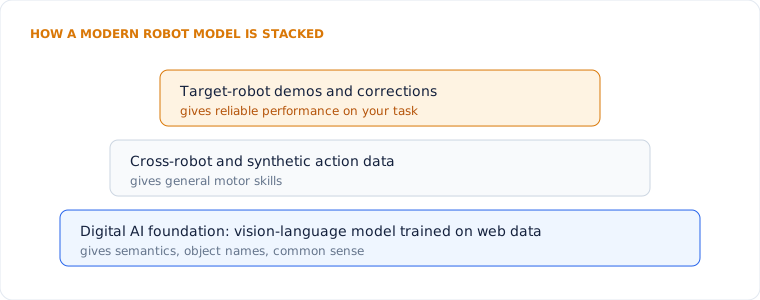
Digital AI provides the foundation. Captured physical data turns it into a robot that can act reliably on a specific task.
What digital AI teams get wrong when they go physical
Dev's team eventually found their footing, but the first quarter taught them some hard lessons that we see repeated across software-first companies moving into robotics.
- Treating data as a download. They budgeted for compute and engineers, not for operators, rigs, and calibration. In physical AI, data collection is an operational program, not a one-time purchase. We call it the work nobody sees for a reason.
- Trusting offline metrics. Validation loss looked great. Real trials told a different story because of compounding errors. Real-world evaluation needs to start early.
- Ignoring the boring metadata. Timestamps drifted between cameras by a few frames. The model learned that the gripper closed before it touched the object. Synchronization is a correctness issue, not a nice-to-have.
- Skipping failure data. They filtered out every episode where something went wrong. The policy had no idea what to do after a slip.
What we see in the field
Software teams are often surprised by how much of physical AI work happens before training starts: rig design, camera placement, operator qualification, session QA, and format conversion. In our teleoperation projects, data captured on real robots has gone straight into post-training vision-language-action models, but only because the capture pipeline was designed around the training format from day one. That's the operational layer our physical AI data collection service exists to handle.
Which one does your project need?
Ask a simple question: does the AI's output change something physical without a person checking it first? If yes, you're building physical AI, and you'll need real-world data, safety thinking, and field testing. New to the field? Start with what physical AI is. If no, you're in digital AI territory, even if the subject matter is physical, like predicting machine failures from sensor logs.
If you're on the physical side, start with our explainer on how physical AI works, then read about physical AI training to see what the data pipeline looks like. For a related distinction that often causes confusion, see physical AI vs embodied AI. And when you need data that doesn't exist yet, the Gamasome team can capture it.