
People never understand the world through a single sense. We watch, listen, read, feel and move — all at once — and our brains combine those signals into one picture. The most advanced AI systems are now being built the same way. Self-driving cars fuse cameras, LiDAR and radar. Humanoid robots combine vision, touch, joint positions and spoken instructions. Vision-language models connect images to words.
None of that works without multimodal data annotation: labeling several data streams together so a model learns how they relate. This guide explains what multimodal annotation is, the key techniques involved, what high-quality multimodal datasets look like, and how to build them for real-world AI.
Key Takeaways
• Multimodal data annotation labels two or more data types — such as video, LiDAR, audio, text and sensor readings — in a synchronized, consistent way
• It lets AI systems cross-check one sense against another, which makes them more robust in noise, darkness, bad weather and other edge cases
• The hardest parts are time synchronization, sensor calibration and keeping object identities consistent across every stream
• Leading datasets in autonomous driving, egocentric video and robotics show that multimodal labeling at scale is what unlocks generalization
What Is Multimodal Data Annotation?
Multimodal data annotation is the process of labeling data captured from multiple sources at the same moment, and linking those labels so they describe a single shared reality. A pedestrian tagged in a camera frame should be the same pedestrian, with the same ID, in the matching LiDAR point cloud and radar return. A spoken instruction ("pick up the red cup") should be tied to the exact video frames and robot joint movements that carry it out.
This builds on the fundamentals of data annotation, but adds a new dimension: relationships between modalities. Labeling each stream separately is not enough. The value comes from the alignment.
Why Advanced AI Is Going Multimodal?
Single-modality models hit natural limits. A camera struggles in glare and darkness. LiDAR can't read a stop sign's text. Audio alone can't tell a robot where a sound came from. Combining modalities lets each one cover the others' blind spots — the principle behind sensor fusion in physical AI.
The shift is visible across the field:
• Vision and language. OpenAI's CLIP learned visual concepts by matching images with their captions across 400 million image–text pairs, and could then classify images zero-shot — matching the original ResNet-50's ImageNet accuracy without using any of its 1.28 million labeled training examples. Pairing modalities created a far more flexible model.
• Autonomous driving. The nuScenes dataset was built around the full vehicle sensor suite — six cameras, five radars and one LiDAR with 360-degree coverage — because real self-driving systems depend on all of them together.
• Robotics. The Open X-Embodiment collaboration pooled more than one million real robot trajectories from 22 robot types. Models trained on this mixed data outperformed models trained on a single robot's data by around 50% in small-data settings, showing how diverse, well-structured multimodal data drives generalization.
The common thread: the more senses an AI combines, the more carefully those senses must be labeled and aligned.
Key Modalities and How Each Is Annotated
Images and Videos
Visual data is labeled with bounding boxes, polygons, semantic and instance segmentation, keypoints for human pose, and object tracking IDs across frames. Video adds temporal labels — when an action starts and ends. Our guide to video and motion data in physical AI covers this in depth.
LiDAR and 3D Point Clouds
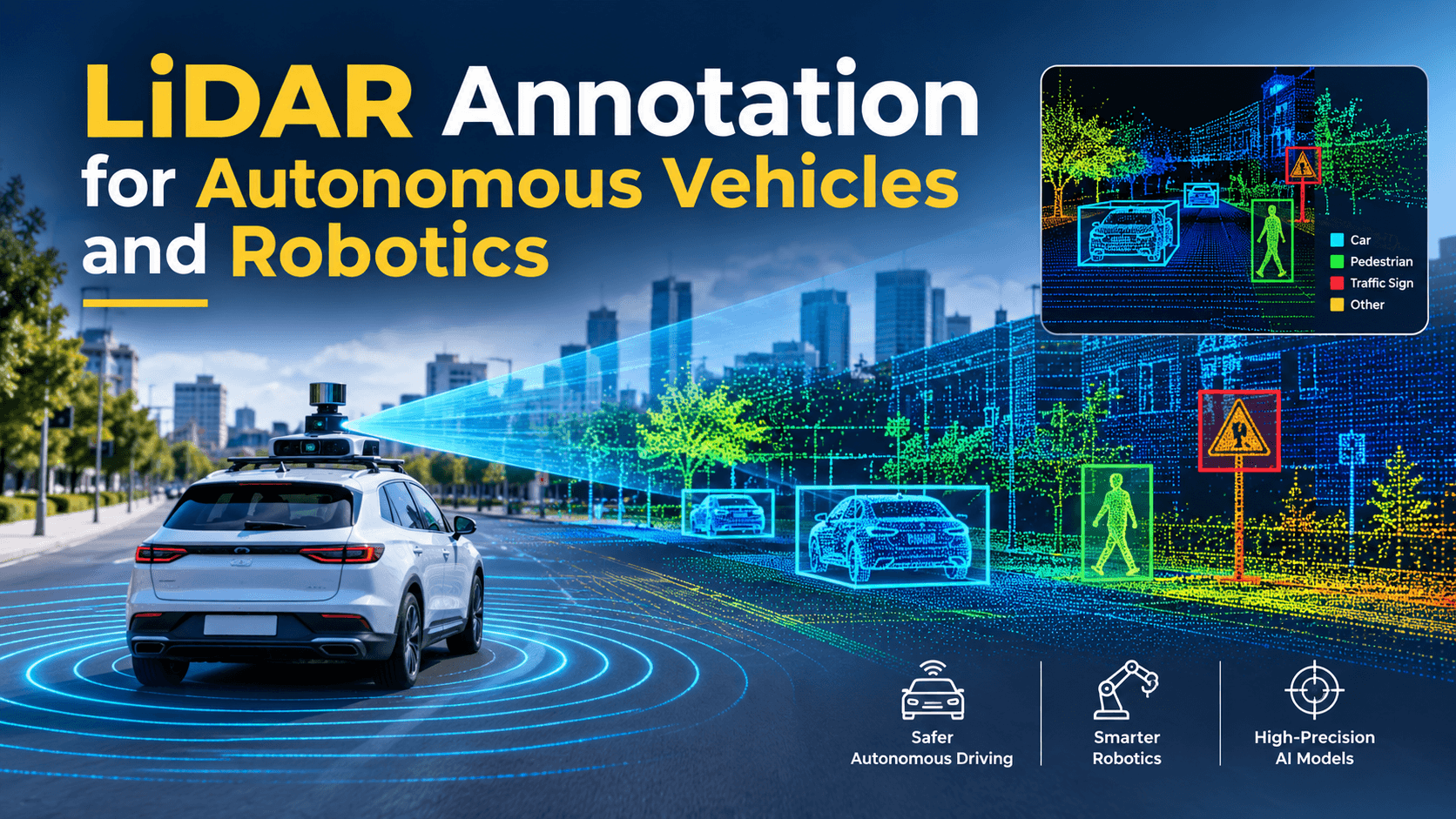
LiDAR produces millions of 3D points per second. Annotators draw 3D cuboids around objects, segment points by class (road, vehicle, vegetation), and track objects through time. Learn more about our LiDAR data collection and 3D point cloud data collection services.
Radar
Radar data is sparse but works in rain, fog and darkness and measures velocity directly. Radar returns are typically labeled by associating them with objects already annotated in camera or LiDAR data.
Audio
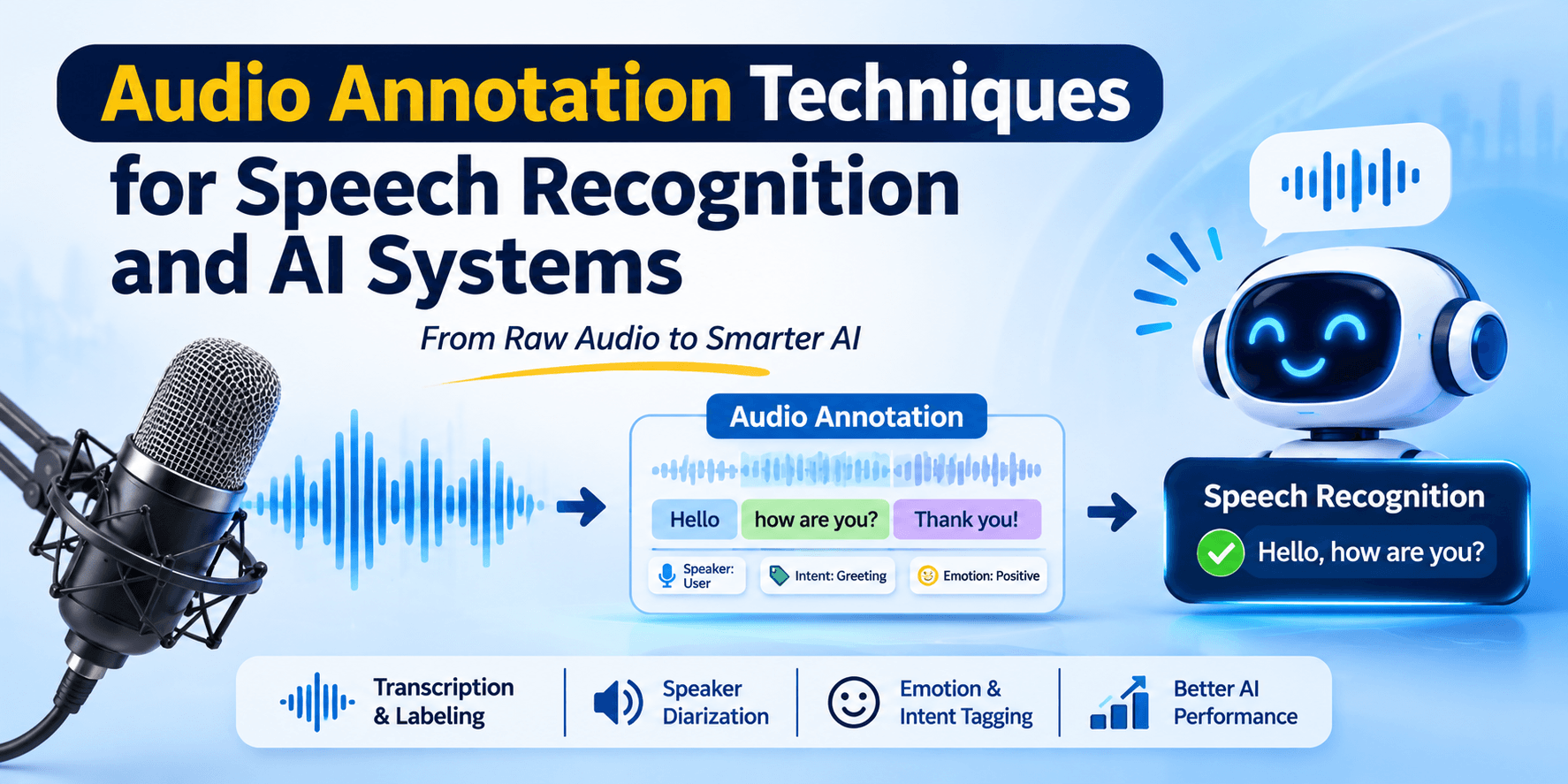
Speech is transcribed and speakers labeled; non-speech sounds like alarms, horns or machinery are tagged by type and time. In multimodal systems, audio events are linked to the visual source that produced them.
Text and Language
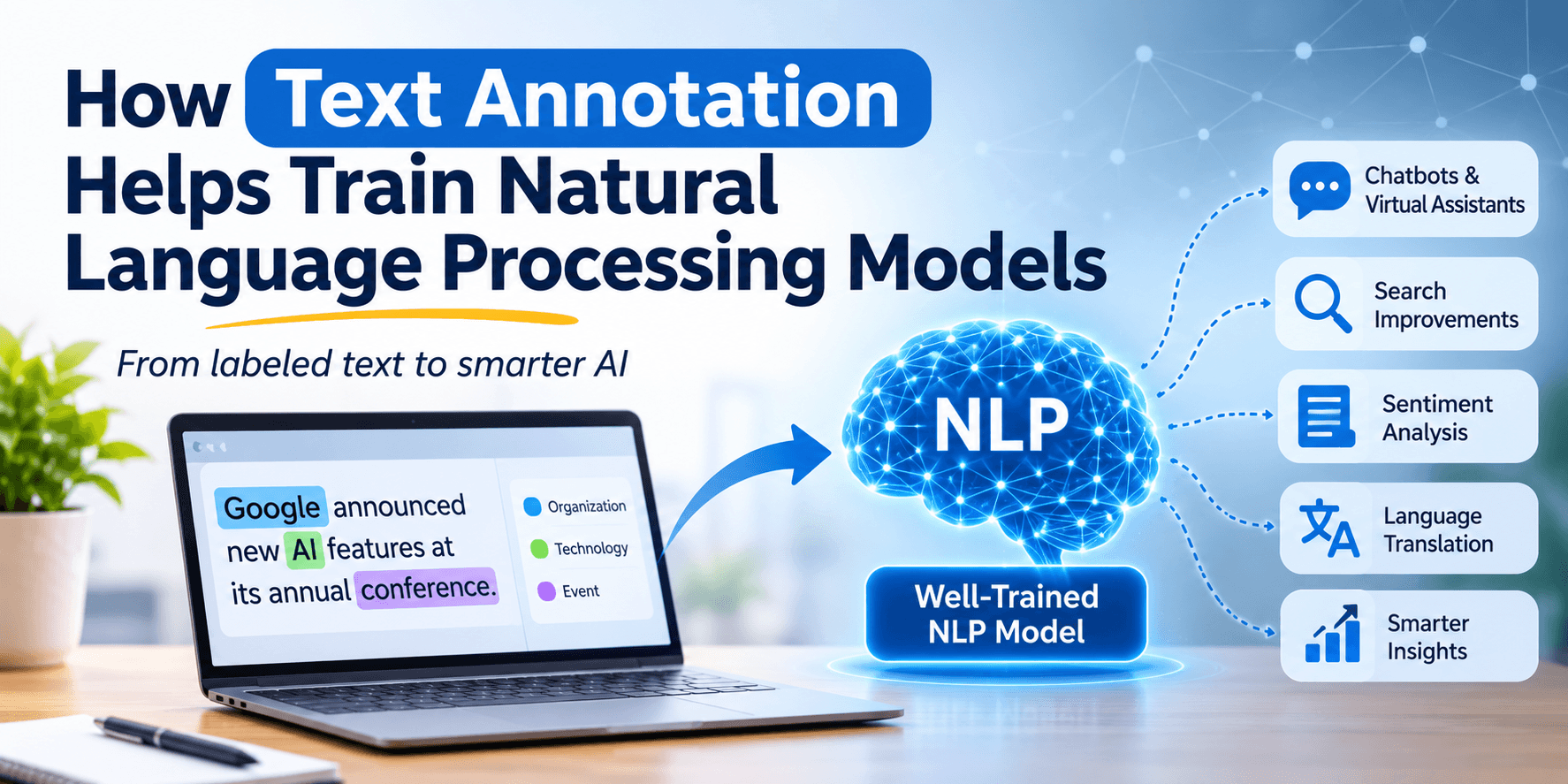
Text includes captions, scene descriptions, step-by-step narrations and natural-language commands. These labels let models connect what they see to how people describe it — the foundation of vision-language and vision-language-action models.
Inertial, Proprioceptive and Force data
IMU readings, joint angles, gripper states, force and torque sensors record how a body or robot moves and makes contact. They are annotated with action phases (reach, grasp, lift, place), success or failure, and contact events — critical for robot demonstration data.
Depth, Thermal and Other sensors
Depth cameras, thermal imaging and GPS add further context. Each needs its own labels, plus alignment to the rest of the sensor stack.
Core Multimodal Annotation Techniques
1. Temporal Synchronization
Every sensor records at a different rate — a camera at 30 frames per second, LiDAR at 10 sweeps per second, an IMU hundreds of times per second. Annotation starts by aligning all streams to a shared clock so a label at one moment means the same moment everywhere. Even small timing offsets can put a fast-moving object in the wrong place.
2. Calibration-aware Cross-Modal Labeling
Using each sensor's calibration (its position and orientation relative to the others), annotators project 3D LiDAR labels onto 2D camera images and vice versa. Labeling in one view and verifying in another catches errors that a single view would miss.
3. Consistent object Identity Across Streams and Time
Each real-world object receives one ID that persists across every sensor and every frame. Consistent IDs are what teach models to track, predict motion and reason about cause and effect.
4. Language Grounding and Narration
Annotators write captions, timestamped narrations or instructions tied to specific frames, regions or actions. Meta's Ego4D dataset is a striking example: 3,670 hours of first-person video from 931 participants, with millions of annotations — including dense written narrations — produced through more than 250,000 hours of annotator effort.
5. Action and Trajectory Segmentation
For embodied AI, recordings are split into meaningful steps, each labeled with the action performed, the objects involved and whether it succeeded. This is especially important for teleoperation data and human demonstrations.
6. Scene-level and Condition Metadata
Weather, lighting, location type, crowd density and sensor health are tagged per scene. This metadata lets teams balance datasets and measure model performance by condition.
Multimodal Annotation at a Glance
| Modality Combination | Typical Annotation | AI Application |
|---|---|---|
| Camera + LiDAR + radar | 2D boxes, 3D cuboids, shared track IDs | Autonomous vehicles, ADAS |
| Image + text | Captions, region–phrase grounding | Vision-language models, visual search |
| Video + audio | Sound source linking, speaker labels | Surveillance, media AI, assistants |
| Video + language + robot state | Narrations, action segments, success labels | Humanoids, robot manipulation |
| Video + IMU | Activity and gesture labels | Wearables, AR glasses, health monitoring |
| Aerial imagery + LiDAR + GPS | Terrain, object and change labels | Drones, agriculture, mining, mapping |
How Multimodal Annotation Supports Advanced AI
• Robustness: When one sensor fails — a camera blinded by sun, a microphone drowned by noise — a model trained on aligned multimodal data can lean on the others.
• Grounded Understanding: Linking words to pixels and points teaches models what language actually refers to in the physical world.
• Better Generalization: Diverse, aligned data across environments and hardware helps models transfer to new settings, a key theme in generalization in physical AI.
• Safer Edge-case Handling: Rare events — a child running behind a parked car, a dropped tool on a factory floor — are easier to detect when multiple sensors confirm them. Targeted edge case data collection fills these gaps.
• Reliable Evaluation: Multimodal ground truth lets teams test each sensor pipeline and the fused system against the same reference.
The scale of annotation effort matters too. nuScenes, for example, labeled 1,000 driving scenes with 3D bounding boxes across 23 classes and 8 attributes, delivering 7 times as many annotations and 100 times as many images as the earlier KITTI benchmark — and became a standard for training and comparing perception models.
The Multimodal Annotation Workflow
1. Define the AI task and modalities. Decide which sensors matter, what the model must predict, and the label taxonomy for each stream.
2. Plan and capture data. Collect in realistic environments with calibrated, time-synced hardware, using multimodal data collection designed for annotation from the start.
3. Synchronize and calibrate. Align timestamps, verify calibration and flag dropped frames or sensor faults before labeling.
4. Write unified guidelines. One document should define classes, IDs, boundaries and edge cases across every modality.
5. Annotate with model assistance. Use pre-labels from existing models, then have trained annotators correct and link them across views.
6. Cross-modal QA. Check that labels agree between sensors, IDs stay consistent, and language matches the actions it describes.
7. Train, evaluate and iterate. Find failure modes by condition and modality, and collect and annotate more data where models are weakest.
Measuring Multimodal Annotation Quality
Standard metrics still apply — Intersection over Union (IoU) for boxes and masks, agreement scores for classifications, Word Error Rate for transcripts. Multimodal projects add their own checks:
• Synchronization error: the time offset between sensors for the same event.
• Cross-modal consistency: how often a 3D label projects correctly onto the matching 2D image.
• ID consistency: the number of identity switches when tracking an object across frames and sensors.
• Completeness: whether every object visible in one modality is labeled in the others where it should be.
Our guides to data quality in AI training and physical AI data quality go deeper on setting and tracking these targets.
Challenges in Multimodal Annotation
• Volume and cost. Every extra sensor multiplies the data to label. Smart sampling and model-assisted labeling are essential.
• Synchronization and calibration drift. Sensors shift over time; small misalignments create large label errors.
• Tooling complexity. Annotators need tools that display and link 2D, 3D, audio and text views together.
• Specialist skills. 3D point-cloud labeling, robot action segmentation and domain-specific language require trained annotators.
• Privacy and consent. Video and audio capture faces, voices and locations. Consent, de-identification and secure handling are mandatory — Ego4D, for instance, used consenting participants and de-identification procedures.
• Real vs synthetic balance. Simulation helps with scale, but real-world multimodal data captures the noise and messiness models will face. See synthetic vs real-world data for robotics.
Real-World Applications
• Automotive: perception and prediction for ADAS and self-driving in the automobile and trucking sectors.
• Humanoid robotics: robots that see, hear, follow instructions and handle objects — see our work in humanoid robotics and data collection for humanoid robots.
• Warehouses and logistics: picking robots and autonomous mobile robots in warehouse environments.
• Healthcare: surgical video combined with instrument data, or patient monitoring that blends video, audio and vital signs in healthcare.
• Agriculture, construction and mining: drones and machines that combine aerial imagery, LiDAR and GPS — including drone and aerial data collection.
• Manufacturing: inspection and assembly systems that fuse vision, force and acoustic signals in manufacturing.
In-House vs Outsourced Multimodal Annotation
Multimodal projects are among the hardest to staff internally. They require synchronized capture hardware, specialized 3D and multi-view tools, and annotators trained across several data types. Many teams keep taxonomy design and final acceptance in-house while partnering with a specialist for capture, labeling and QA. Our comparison of in-house vs outsourced data annotation lays out the trade-offs.
How Gamasome Supports Multimodal AI Development
Gamasome specializes in real-world data for physical AI. We collect synchronized video, LiDAR, audio, IMU and robot-state data in the environments where your systems will actually operate, and our physical AI annotation team labels it with consistent IDs, cross-modal QA and measurable quality targets.
From teleoperation data collection for robot learning to edge-case capture for perception systems, we help AI teams move from raw sensor streams to model-ready multimodal datasets faster.
Building a multimodal AI system? Talk to our team about your sensors, environments and accuracy goals.