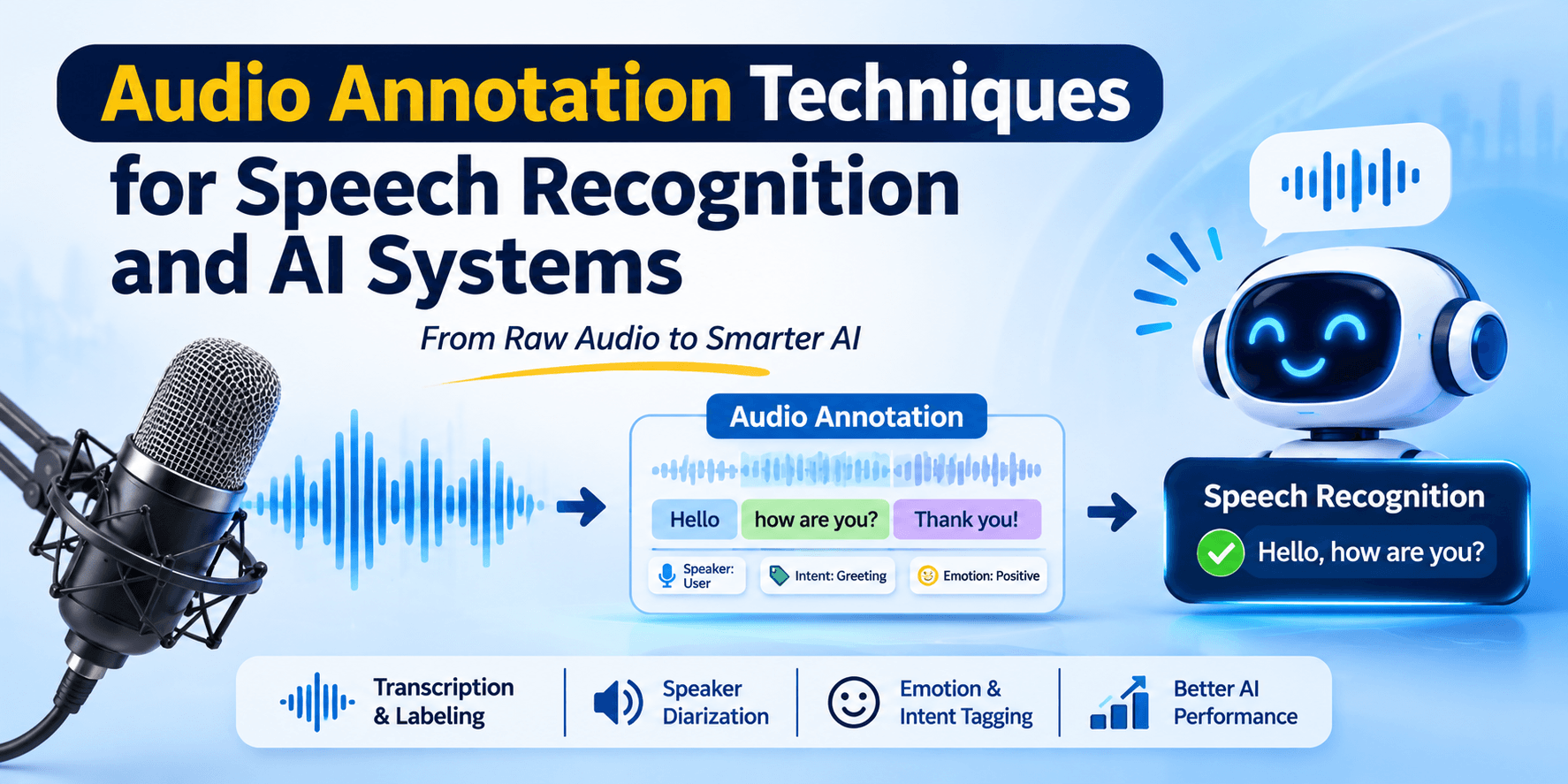

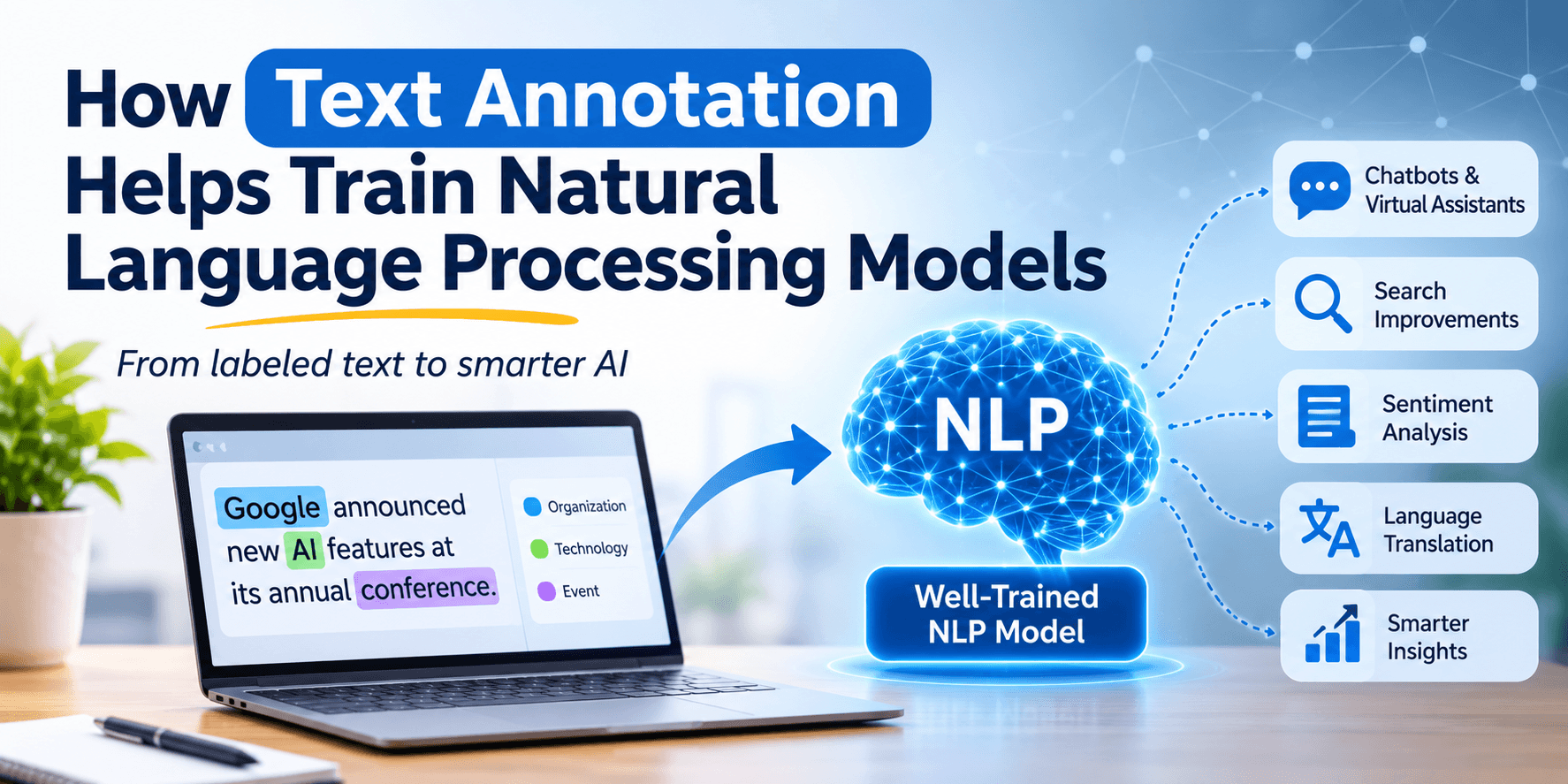
Every chatbot that understands a complaint, every search engine that grasps what you meant, and every large language model that follows an instruction has one thing in common: somewhere in its training pipeline, people labeled text. Algorithms are good at spotting patterns, but they cannot decide on their own which words name a company, whether a review is sarcastic, or which of two answers is more helpful. Text annotation supplies that judgment.
This guide explains how text annotation works, the main annotation types and what each one teaches a model, how to measure label quality, and how to decide between building an annotation team and partnering with a specialist.
Key takeaways
• Text annotation adds structured labels — entities, sentiment, intent, relations, rankings — to raw text so supervised models can learn from it.
• Label quality matters as much as data volume. Even well-known benchmark datasets contain measurable label errors that can change which model looks best.
• Modern LLMs still rely on human-annotated text through instruction tuning and reinforcement learning from human feedback (RLHF).
• Clear guidelines, gold-standard checks and inter-annotator agreement metrics are what separate usable training data from noise.
What Is Text Annotation?
Text annotation is the process of attaching meaningful labels to pieces of text — a word, a phrase, a sentence or an entire document — so that a machine learning model can learn the relationship between language and meaning. If you are new to the wider field, our primer on what data annotation is covers the fundamentals that apply across text, image, video and sensor data.
A single customer email might be annotated in several ways at once: the product name tagged as an entity, the overall tone marked as negative, the request classified as a refund intent, and the date linked to an order record. Each layer of labels teaches the model a different skill.
You will often hear "annotation" and "labeling" used interchangeably. There is a subtle difference — labeling usually means assigning a single tag, while annotation can include spans, relationships and richer context. We break this down in data annotation vs data labeling.
Why NLP Models Depend on Annotated Text
From raw text to a learning signal
Raw text is unstructured. A supervised model needs examples of input paired with the correct output so it can adjust its parameters until its predictions match. Annotation creates those pairs. Without them, a model has no way of knowing that "Apple" in one sentence is a fruit and in another is a company.
India's national AI portal IndiaAI highlights that one of the biggest obstacles in building NLP systems is getting training sets that are large, diverse and accurately labeled — not the model architecture itself.
Annotation in the age of large language models
It is tempting to assume that LLMs trained on internet-scale text no longer need human labels. In practice, the opposite is true. Pre-training teaches a model to predict the next word; it does not teach it to be helpful, truthful or safe.
OpenAI's InstructGPT research showed how this gap is closed with human-annotated data. Labelers wrote demonstrations of ideal responses for supervised fine-tuning, then ranked model outputs so a reward model could learn human preferences. The result was striking: people preferred answers from a 1.3-billion-parameter model trained this way over those from the 175-billion-parameter GPT-3, despite the smaller model having roughly 100 times fewer parameters. Carefully annotated text, in other words, can outperform raw scale.
Types of Text Annotation and What Each Teaches a Model
Different NLP tasks need different kinds of labels. Here are the most common types, with the capability each one builds.
1. Entity Annotation and Named Entity Recognition (NER)
Annotators highlight spans of text and tag them with categories such as person, organization, location, date, product, drug name or policy number. This trains models to extract structured information from documents — the backbone of resume parsers, contract analysis tools and clinical text mining. TELUS Digital describes entity annotation as one of the most important steps in building chatbot and NLP datasets, alongside keyphrase tagging.
2. Entity Linking
Once an entity is found, entity linking connects it to a specific record in a knowledge base. "Paris" is linked to the French capital rather than a person named Paris. This teaches disambiguation and powers knowledge graphs and smarter search.
3. Text Classification
An entire document, paragraph or sentence receives one or more labels: spam or not spam, billing or technical support, urgent or routine. Classification is often the quickest annotation task to scale and delivers immediate business value in routing and moderation.
4. Sentiment and Emotion Annotation
Annotators label text as positive, negative or neutral, and sometimes with finer emotions like frustration, joy or confusion. Aspect-based sentiment goes further, tagging opinion about specific features ("battery life: negative, screen: positive"). This is how brands analyze reviews and social posts at scale.
5. Intent Annotation
Intent labels capture what the writer wants to do — book, cancel, compare, complain, ask for information. Intent data is essential for conversational AI, voice assistants and customer-service automation.
6. Relation and Semantic Annotation
Here annotators mark how entities relate: a drug treats a condition, a company acquired another, a clause depends on a date. Relation labels let models answer complex questions and build structured knowledge from free text.
7. Linguistic Annotation
Part-of-speech tags, dependency parses, coreference chains ("she" refers to "Dr. Rao") and semantic roles give models a grammatical understanding of language. These labels are especially valuable for low-resource languages, including many Indian languages, where pre-built tools are limited.
8. Preference, Ranking and Evaluation Annotation for LLMs
The newest and fastest-growing category. Annotators compare two or more model responses and choose the better one, rate outputs for accuracy or harmfulness, or write ideal reference answers. This data feeds supervised fine-tuning, RLHF and ongoing model evaluation.
How Text Annotation Improves NLP Model Performance
Good annotation does more than make training possible. It directly shapes how well a model performs once deployed.
• Higher accuracy: Consistent labels give the model a clean signal. Inconsistent labels force it to learn contradictions.
• Domain expertise: A general model does not know insurance jargon or medical abbreviations. Domain-specific annotation teaches it the vocabulary of your industry.
• Edge-case coverage: Rare phrasing, slang, code-switching between languages and sarcasm are where models fail. Targeted annotation of these cases — the text equivalent of edge case data collection — closes those gaps.
• Bias reduction: Balanced, well-documented annotation helps teams spot and correct skew in how different groups or dialects are represented.
• Trustworthy evaluation: Annotated test sets are how you know whether a model actually improved.
That last point is often overlooked. A widely cited MIT and Cleanlab study estimated an average label error rate of 3.4% across the test sets of ten popular computer vision, language and audio benchmarks. The researchers found that these errors were enough to change which model appeared to perform best — meaning teams could ship the wrong model based on flawed labels. You can browse examples at labelerrors.com. For a deeper look at this topic, read our guide to data quality in AI training.
The Text Annotation Workflow, Step by Step
High-quality NLP datasets follow a repeatable process.
1. Define the task and label schema: Decide exactly what the model must learn and list every label with a clear definition. Fewer, well-defined labels usually beat long, overlapping lists.
2. Write annotation guidelines: Include positive and negative examples, rules for entity boundaries, and instructions for ambiguous cases. The open Text Annotation Handbook is a practical reference for structuring guidelines.
3. Collect and prepare data: Gather representative text, remove duplicates, and mask personal information before annotators see it.
4. Run a pilot: Have several annotators label the same small batch, measure agreement, and revise the guidelines where they disagree.
5. Annotate at scale: Use a suitable tool, and consider model-assisted pre-labeling so humans correct suggestions rather than starting from scratch.
6. Review and quality-check: Seed hidden gold-standard items, run second-pass reviews, and track each annotator's accuracy.
7. Train, evaluate and iterate: Use model errors to find confusing labels or missing examples, then annotate more data where the model is weakest. This active-learning loop gets more value from every labeled example.
Measuring Annotation Quality: Inter-Annotator Agreement
How do you know whether your labels are reliable? The standard answer is inter-annotator agreement (IAA): how often independent annotators assign the same label to the same item.
Raw percentage agreement can be misleading. If 90% of your data belongs to one class, two annotators will agree often by pure chance. UC Berkeley's NLP course materials illustrate exactly this problem and why chance-corrected metrics are used instead.
• Cohen's kappa compares two annotators while correcting for chance agreement.
• Fleiss' kappa extends the idea to three or more annotators.
• Krippendorff's alpha handles missing labels and different data types, making it flexible for complex projects.
A commonly used rule of thumb (Landis and Koch) interprets kappa scores like this:
| Kappa score | Level of agreement | What it usually means |
|---|---|---|
| Below 0.20 | Slight | Guidelines are unclear or the task is too subjective |
| 0.21 – 0.40 | Fair | Acceptable only for low-stakes tasks |
| 0.41 – 0.60 | Moderate | Guidelines need refinement |
| 0.61 – 0.80 | Substantial | Good, production-ready for most use cases |
| 0.81 – 1.00 | Almost perfect | Ideal for high-stakes domains like healthcare and legal |
Low agreement • Healthcare: extracting symptoms, drugs and dosages from clinical notes; supporting medical coding. See how AI data is used in healthcare.
• Insurance: classifying claims, flagging possible fraud signals and pulling key fields from policy documents — relevant to teams in insurance.
• Customer support: intent and sentiment labels that route tickets and train chatbots.
• E-commerce: product attribute extraction, review sentiment and search relevance labeling.
• Legal and finance: clause classification, entity extraction from contracts and risk detection in filings.
• Robotics and physical AI: natural-language instructions and narrations paired with video or sensor data teach robots to connect words to actions — a growing area covered in our work on multimodal data collection.is not just a number to report — it is a diagnostic. It usually signals that the guidelines are ambiguous, the label schema overlaps, or annotators need more training. A 2026 survey from the ACL Anthology reviewing 25 years of NLP research found that agreement is still measured and reported inconsistently, which makes it worth defining your quality metrics up front.
Common Challenges in Text Annotation
• Ambiguity and subjectivity: Sarcasm, humor and mixed sentiment are hard even for people. Clear tie-breaking rules and adjudication by a senior reviewer help.
• Domain knowledge: Medical, legal and financial text needs annotators who understand the terminology, or at least expert reviewers.
• Scale Vs. consistency: Adding more annotators speeds things up but can lower consistency without strong onboarding and calibration.
• Privacy and security: Support tickets, health records and claims files contain personal data. Anonymization, access controls and secure workflows are non-negotiable.
• Annotator fatigue: Long sessions on repetitive tasks reduce accuracy. Rotating tasks and tracking quality over time protect the dataset.
Real-World Applications of Text Annotation
• Healthcare: Extracting symptoms, drugs and dosages from clinical notes; supporting medical coding. See how AI data is used in healthcare.
• Insurance: Classifying claims, flagging possible fraud signals and pulling key fields from policy documents — relevant to teams in insurance.
• Customer support: Intent and sentiment labels that route tickets and train chatbots.
• E-commerce: Product attribute extraction, review sentiment and search relevance labeling.
• Legal and finance: Clause classification, entity extraction from contracts and risk detection in filings.
• Robotics and physical AI: Natural-language instructions and narrations paired with video or sensor data teach robots to connect words to actions — a growing area covered in our work on multimodal data collection.
In-House Vs. Outsourced Text Annotation
Building an internal annotation team gives you tight control and keeps sensitive data close, but it is slow to scale and expensive to manage. Outsourcing to a specialist gives you trained annotators, established quality processes and the ability to ramp up quickly — with the trade-off of needing a partner you trust on security and accuracy.
Many teams choose a hybrid: in-house experts define guidelines and review edge cases, while an external partner handles volume. We compare the costs, risks and decision criteria in detail in in-house vs outsourced data annotation.
How Gamasome Helps Teams Build Better AI Training Data
At Gamasome, we build training data for AI systems that need to work reliably in the real world. Our data annotation services combine trained human annotators, documented guidelines, multi-stage review and measurable quality metrics — the same principles that make text datasets dependable.
If your models combine language with images, video, audio or sensor streams, we can collect and annotate that data together so every modality is aligned. Whether you are fine-tuning an assistant, building a domain-specific classifier or teaching a robot to follow spoken instructions, we help you get from raw data to a model-ready dataset faster.
Ready to improve your NLP training data? Talk to our team about your project, data volume and quality targets.